
Your gig platform’s success depends on one thing: keeping your best talent active. But when 1099 payment automation is slow or clunky, your top performers will migrate to whoever pays them fastest. Speed isn’t just a nice feature anymore; it’s the baseline expectation for anyone working in the gig economy today.
The infrastructure gap is real. Your engineering team can build a marketplace that matches supply and demand perfectly, but if your payment rails can’t deliver funds in real-time, you lose talent to platforms that can. The best gig economy payment solutions handle this complexity programmatically, automating everything from tax form collection to instant settlement, so your operations team doesn’t become a bottleneck as you scale.
This guide evaluates seven payment platforms based on what actually matters for high-volume gig networks: API integration speed, payout rail options (RTP, Same Day ACH, push-to-card), automated tax compliance, and the payee experience that keeps contractors coming back.
TLDR:
-
Gig economy payment solutions automate high-volume payouts to contractors using API or CSV uploads.
-
Real-Time Payments (RTP) and Same Day ACH are critical for retaining gig workers who switch platforms for faster pay.
-
Automated W-9 collection and 1099 filing prevent compliance bottlenecks as your contractor network scales.
-
Routable handles 10,000+ monthly payments with API integration in under 3 days and payouts to 220+ countries.
What Are Gig Economy Payment Solutions?
Gig economy payment solutions are specialized disbursement engines designed to handle high-volume payouts to independent contractors. Unlike traditional business-to-business transactions that rely on slow invoice cycles, these tools focus on speed and scale. They allow marketplaces to pay thousands of drivers, creators, or delivery partners simultaneously without manual intervention.
For gig businesses, payments are product features, not back-office admin. Retaining talent often comes down to payout speed. If a driver waits three days for funds on one app but gets instant access on another, they switch. These tools prioritize the payee experience by offering flexible methods like Real-Time Payments (RTP) and Same Day ACH.
Structurally, these systems replace manual entry with automation. They use API-first architecture or bulk CSV uploads to manage the entire lifecycle from onboarding and tax form collection (W-8 and W-9) to final settlement. This programmatic approach ensures that as your user base grows, your operations team does not need to add headcount just to process payouts.
How We Evaluated Gig Economy Payment Solutions
With 76 million freelancers in the US alone and blue-collar gig hiring rising 92% year-on-year in 2024, your payment infrastructure must handle scale without breaking.
We focused on criteria that matter to technical operators managing mass payouts over traditional finance teams.
API and Developer Experience
Your engineers need clean documentation, test sandboxes, and idempotency to prevent duplicate transactions during network blips.
Speed and Rail Optionality
Workers expect instant access to funds. These platforms should support for Real-Time Payments (RTP), Same Day ACH, and push-to-card capabilities.
Global Reach
Talent is everywhere. Solutions must handle cross-border payments and currency conversion in 200+ countries.
Compliance Automation
You cannot scale if you are manually collecting W-9s or filing 1099s. The software must handle tax data collection automatically.
Payee Onboarding
Friction during signup hurts retention. Self-service portals where contractors input their own banking details are essential.
Best Overall Gig Economy Payment Solution: Routable
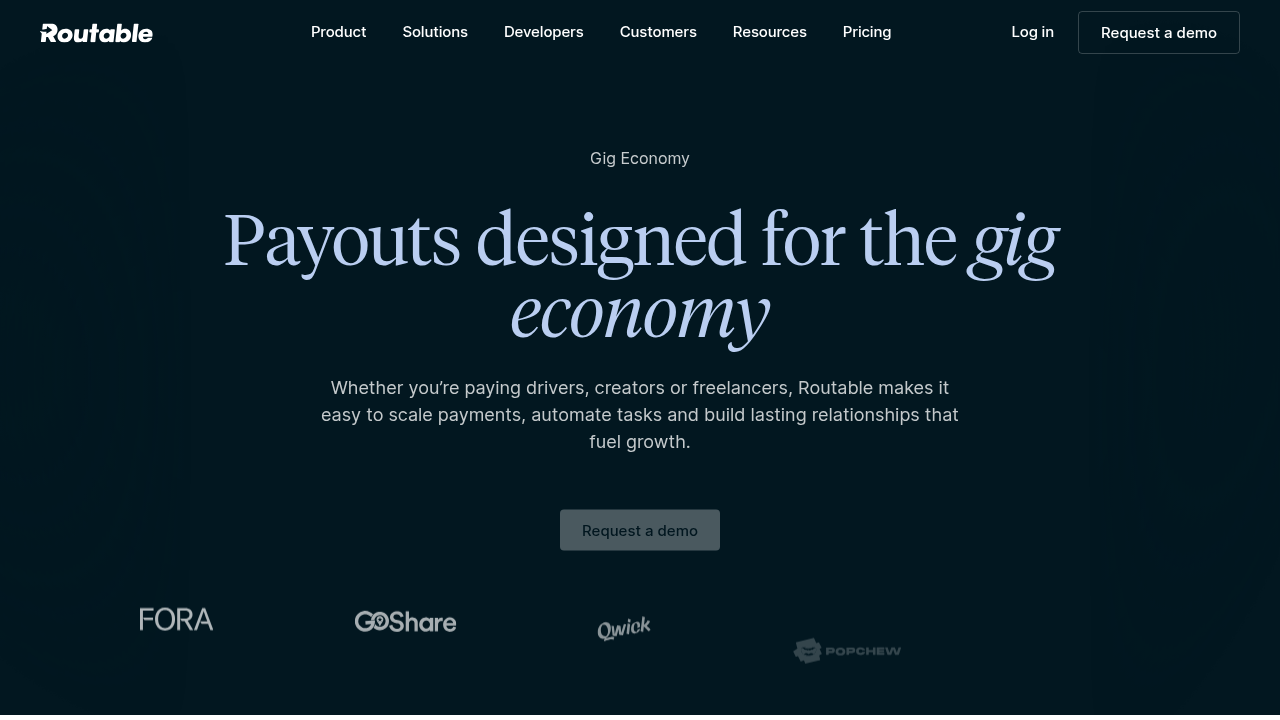
Routable is purpose-built for high-volume mass payouts, serving marketplaces and gig networks that need to send thousands of payments monthly. Unlike generalist tools, our infrastructure allows you to scale transaction volume without increasing headcount. We combine an API-first architecture with no-code CSV upload options, making the system accessible to both engineering teams and operations staff.
For developers, integration speed and reliability are critical. You can connect to our API in under five minutes, with full integration typically taking less than three developer days. We support the fast payout rails your workers expect, including Real-Time Payments (RTP/FedNow), Same Day ACH, push-to-card, PayPal, and Venmo, backed by idempotency to ensure reliability.
Key Capabilities:
-
Automated W-8/W-9 collection, TIN validation, and 6,000+ watchlist checks, plus full 1099/1042-S filing.
-
Payouts to 220+ countries in 140+ currencies using local rails that save 30-50% on FX rates.
-
A self-service portal where contractors track payment status in real-time, reducing support ticket volume.
-
Bi-directional sync with NetSuite, Sage Intacct, QuickBooks Online, and Xero at 99.8% accuracy.
Bottom line:
Routable delivers the payout speed and transparency gig workers demand while giving operators the automation to scale efficiently.
Stripe Connect
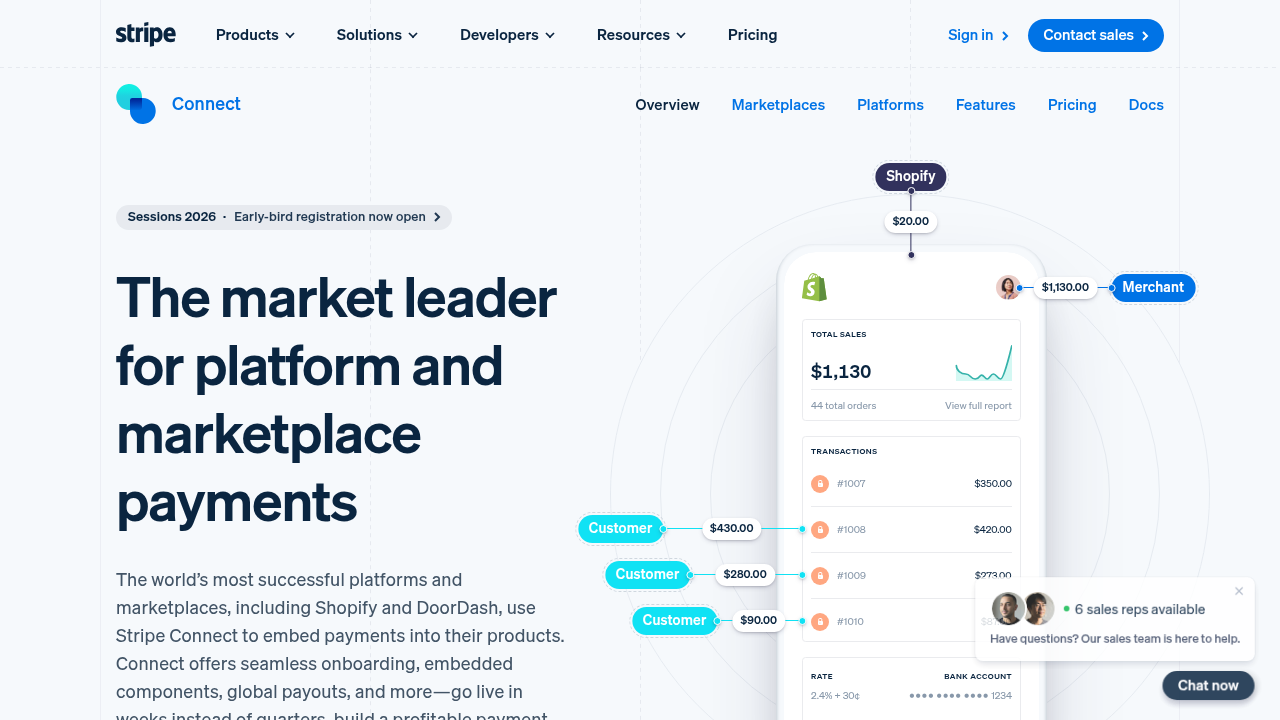
Stripe Connect enables businesses to accept payments and route funds to third parties. It leverages Stripe’s existing infrastructure to move money between accounts. This architecture is a common choice for two-sided marketplaces that need to process incoming transactions from buyers before splitting funds to sellers or service providers.
Key Capabilities:
-
Instant payouts to debit cards along with standard and expedited ACH.
-
Connected account onboarding tools with identity verification.
-
API endpoints for creating programmatic transfers and payouts.
-
Dashboard visibility into connected account activity.
Limitations:
Stripe Connect functions primarily as an acceptance tool, not a dedicated mass payout engine. It introduces friction by requiring payees to create their own Stripe accounts. For operations teams, the lack of native ERP integrations makes reconciliation manual, and there is no support for batch CSV uploads. It also lacks comprehensive tax compliance features like automatic TIN validation and full 1099 filing, which are critical for scaling gig networks.
Bottom line:
Stripe Connect is effective if your priority is payment collection. However, for organizations where disbursements to thousands of contractors are the core requirement, Routable offers superior infrastructure.
Hyperwallet
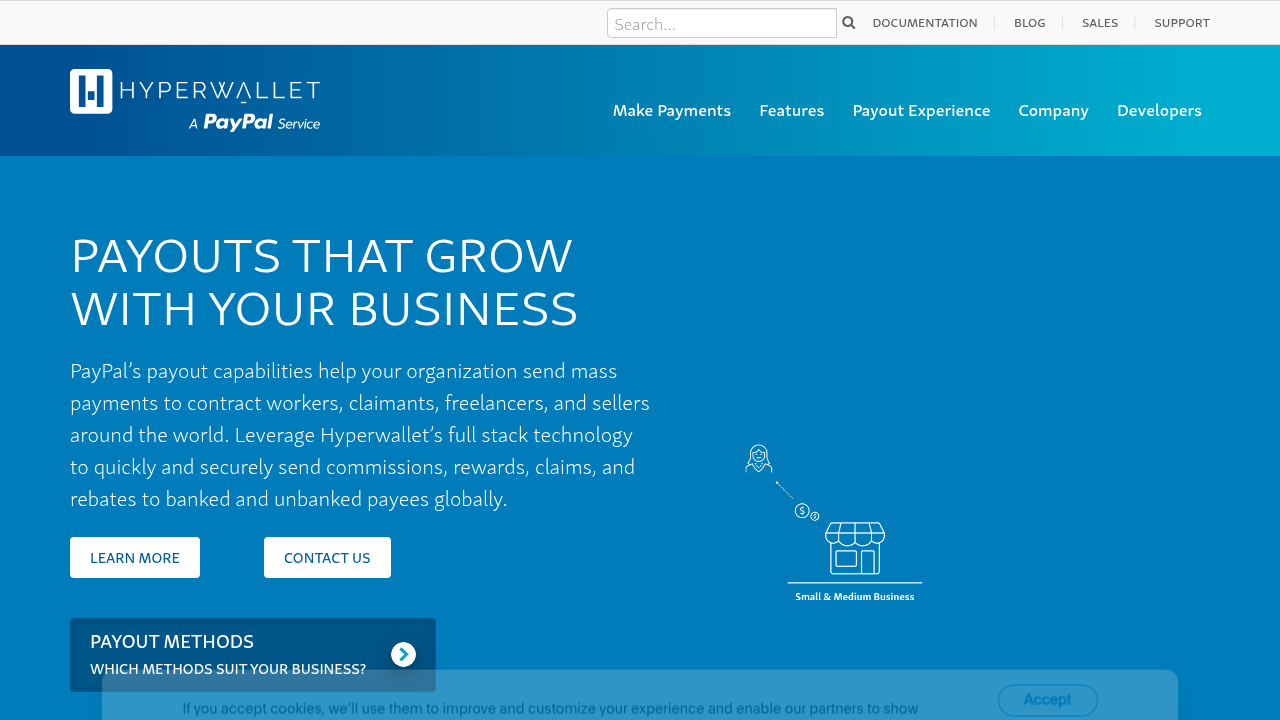
Hyperwallet is a PayPal service that functions as a global payout infrastructure. It operates on a stored-value model, meaning funds are disbursed into a virtual account rather than going directly to a bank immediately. Payees receive the funds in this portal and must then log in to direct the money to their preferred withdrawal method, such as a local bank transfer or prepaid card.
Key Capabilities:
-
Payout capabilities to 200+ countries via local rails.
-
Nine distinct withdrawal options, including PayPal, Venmo, and prepaid cards.
-
A portal where payees manage their own transfer preferences.
-
Tax reporting functionality for US disbursements.
Limitations:
The reliance on a virtual account creates friction. Payees must create a Hyperwallet login and potentially link a separate PayPal or Venmo account to access their money. The system lacks support for true real-time banking rails like RTP and FedNow, limiting instant access to funds. User feedback often points to a difficult user interface and slow support.
Bottom Line:
Hyperwallet is a viable option for PayPal-centric businesses. However, Routable offers a more direct payment flow with transparent pricing, faster domestic rails, and a smoother onboarding experience that puts money in your contractors’ hands faster.
Checkbook
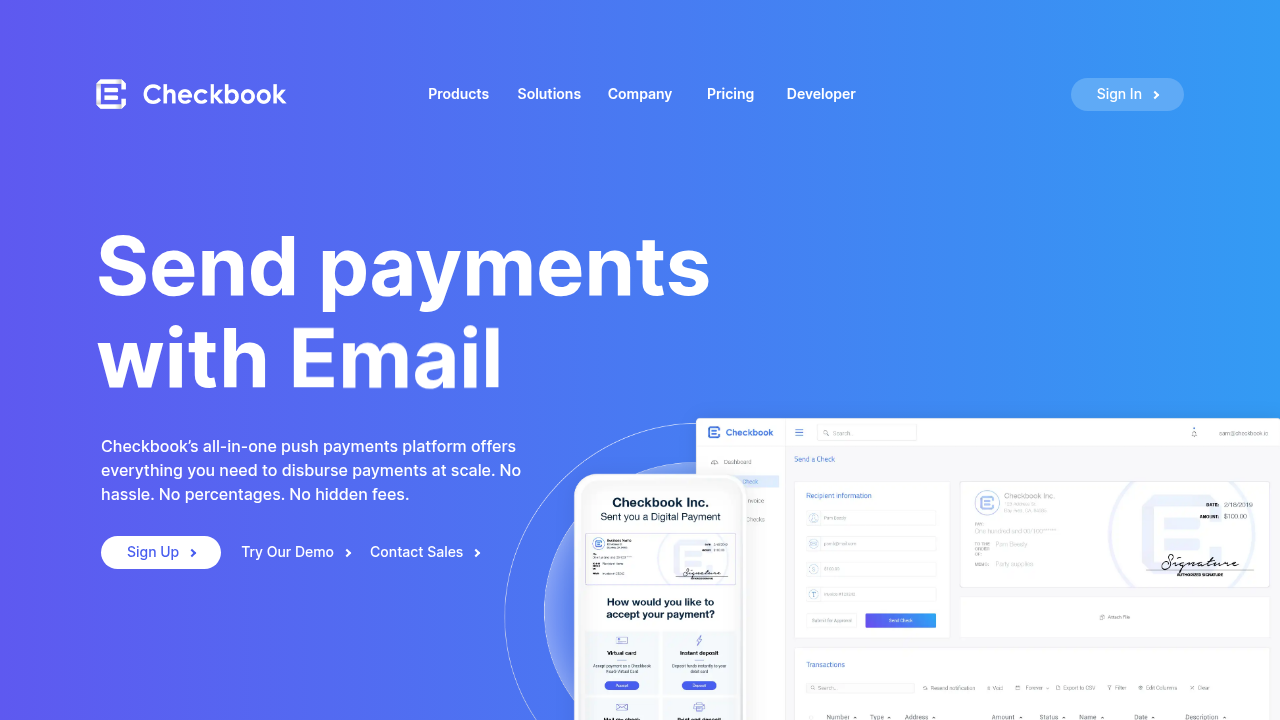
Checkbook provides digital check and ACH payment capabilities with an emphasis on quick setup and straightforward API integration. The service allows businesses to send payments via digital checks that recipients can print or deposit electronically without needing a physical mailing address.
Key Capabilities:
-
Digital check delivery via email, SMS, or through an API call.
-
ACH transfers for direct bank account deposits and wire transfers for same-day delivery of large payments.
-
Push-to-card instant payments to Visa and Mastercard debit cards.
-
Payment automation API includes basic endpoints for initiating payments, checking payment status, and managing recipient information.
Limitations:
Checkbook is designed for general business payments as opposed to high-volume gig economy disbursements. It lacks automated W-9 collection and 1099 filing workflows, which are essential for managing tax compliance at scale. There are no native ERP integrations for accounting reconciliation, and it does not provide white-label payee onboarding portals. The service also has limited international payment support compared to providers offering local rails in 140+ currencies, and it lacks CSV batch upload functionality for operations teams.
Bottom Line:
Checkbook works for businesses transitioning from paper checks to digital payments. However, Routable delivers the tax compliance automation, international reach, and high-volume processing capabilities that gig economy operators require.
Trolley
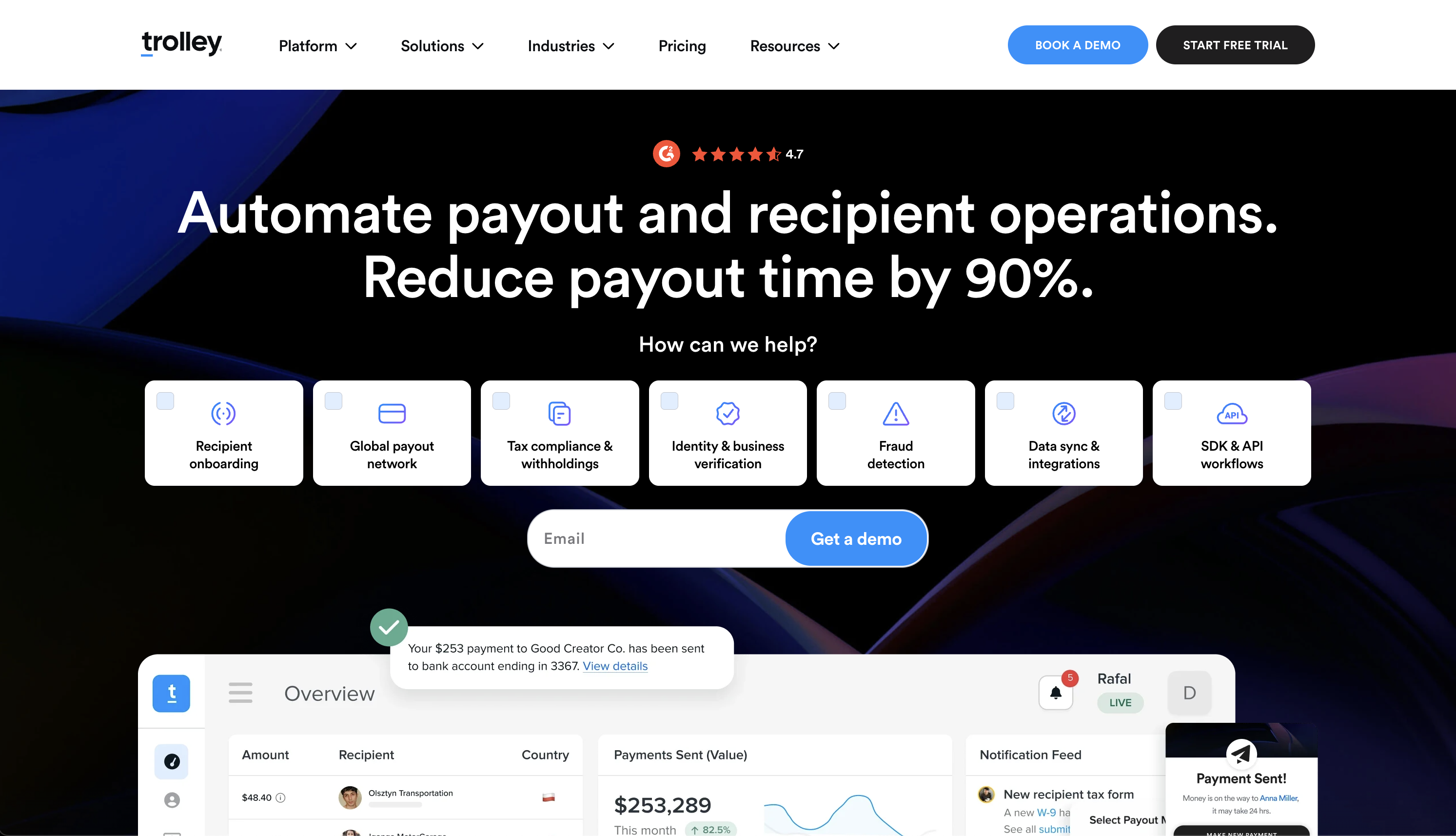
Trolley provides cross-border payment infrastructure for businesses managing a globally distributed workforce. The service emphasizes multi-currency support, allowing companies to send funds to over 210 countries and territories. It provides a hosted payee portal where recipients can manage their own payout preferences, choosing how they wish to receive funds in their local currency.
Key Capabilities:
-
International payments to 210+ countries and territories.
-
Multi-currency support with recipient choice on payout method.
-
REST API that allows developers to programmatically create payments, manage recipient accounts, and track payment status without manual dashboard interaction.
-
Hosted payee portal for managing payment preferences, banking details, and payment history.
Limitations:
Trolley struggles with domestic US speed and efficiency. It lacks Same Day ACH and Real-Time Payments (RTP), relying instead on standard ACH which takes 4-5 business days to settle—a major friction point for gig workers expecting instant pay. The system also does not offer native bi-directional ERP integrations with NetSuite, Sage Intacct, QuickBooks Online, or Xero, forcing finance teams to manually reconcile data. It also lacks automated 1099 preparation and filing functionality, leaving a compliance gap for US-based operations.
Bottom Line:
Trolley serves international-first use cases well. However, Routable provides faster domestic payment rails like RTP, tax automation, and the ERP-native integrations that are critical for gig businesses operating primarily in the US market.
BILL

BILL is a widely known accounts payable automation tool designed to simplify back-office finance operations. It focuses on replacing paper-based processes with digital workflows for invoice capture, approval routing, and vendor payments. The system centralizes document management and payment execution into a single interface tailored for accounting teams.
Key Capabilities:
-
Automated invoice capture with OCR processing.
-
Configurable multi-level approval workflows.
-
Payment execution via standard ACH, paper checks, and international wires.
-
Sync capabilities with QuickBooks, Xero, and NetSuite.
Limitations:
BILL is not engineered for the high-volume, programmatic nature of the gig economy. It lacks an API-first architecture, meaning developers cannot easily trigger payments directly from your application code. The system relies on invoice uploads rather than API or CSV payment instructions, creating friction for mass payouts. It does not support instant payment rails like RTP or push-to-card, and it fails to offer white-label onboarding or self-service portals for payees. The rigid focus on manual approval steps bottlenecks the speed required for paying thousands of contractors.
Bottom Line:
BILL serves traditional finance teams managing invoices well. However, for tech companies needing high-speed, programmatic disbursements without manual intervention, Routable provides the necessary API infrastructure and automation.
Tipalti
Tipalti is a global payables solution geared toward mid-market and enterprise organizations. It bundles accounts payable automation, tax compliance, and procurement workflows into a single heavyweight software suite designed to manage complex international vendor networks.
Key Capabilities:
-
Global payment execution with multi-currency management.
-
Automated tax form collection and compliance features.
-
Invoice processing with three-way purchase order matching.
-
Integrations with major enterprise ERP systems.
Limitations:
Tipalti is often overkill for gig economy networks. Its pricing model and structure target enterprise procurement as opposed to agile mass payouts. The system focuses heavily on invoice processing and PO matching, features that high-growth tech operators calculating payouts programmatically do not need. Implementation is lengthy, often taking months to fully deploy. Unlike API-first solutions that allow developers to integrate in minutes, Tipalti’s architecture is heavier and lacks the rapid, self-service onboarding speed that gig workers expect.
Bottom Line:
Tipalti is a strong choice for traditional corporate finance teams with complex procurement cycles. However, Routable offers the lightweight, fast integration and developer-centric experience necessary to scale gig worker payouts efficiently.
Feature Comparison Table of Gig Economy Payment Solutions
Selecting the right payout infrastructure requires looking beyond marketing claims to the actual technical capabilities. The matrix below highlights the differences between specialized mass payout systems and generalist tools regarding speed, compliance, and developer efficiency.
Why Routable is the Best Gig Economy Payment Solution
Gig platforms succeed or fail based on their ability to retain talent. If your payments are slow, your best drivers and creators will move to a competitor who pays faster. Routable ensures you win on speed by offering the fastest rails available, including Real-Time Payments (RTP/FedNow) and Same Day ACH. We turn disbursements into a competitive advantage, ensuring funds land in accounts instantly rather.
For engineering teams, we eliminate the technical debt associated with building payout infrastructure in-house. Our API is designed for reliability with idempotency key support to prevent duplicate transactions during network failures. While legacy systems often require months to deploy, most developers complete a full Routable integration in less than three days. We handle the complex banking logic so your team can focus on core product features.
Streamlined processes are equally critical as you scale from one thousand to ten thousand payouts. Routable automates the entire tax compliance lifecycle, from collecting W-8 and W-9 forms during onboarding to validating TINs against IRS records. We perform over 6,000 watchlist checks automatically, ensuring you remain compliant without needing to hire additional staff to manage paperwork.
Unlike acceptance-focused tools that leave finance teams cleaning up messy data, we prioritize financial accuracy. Our bi-directional sync pushes payment data directly to NetSuite, Sage Intacct, QuickBooks Online, and Xero with 99.8% accuracy. This eliminates manual reconciliation and gives your finance leaders real-time visibility into cash flow across multiple entities and currencies.
Routable is not an accounts payable tool retrofitted for gig work; it is a specialized mass payout engine. Whether you need to send funds via API or a simple CSV upload, we provide the infrastructure to handle high-volume disbursements globally. By solving for speed, compliance, and developer experience simultaneously, we help you scale your network without breaking your back office.
Final Thoughts on Mass Payout Solutions for Gig Networks
The best 1099 payment automation tools do more than just move money. They handle tax compliance, sync with your ERP in real time, and give your contractors a self-service experience that reduces support tickets. Routable was built for operators who need to send thousands of payments monthly without adding headcount. If your current setup involves CSV exports and manual reconciliation, there’s a better way.
FAQ
How do I choose the right gig economy payment solution for my platform?
Start by identifying your primary constraint: domestic speed, global reach, or developer resources. If you need instant payouts to US-based workers, look for solutions offering Real-Time Payments (RTP) and Same Day ACH. For international contractor networks, verify the provider supports local rails in your target countries.
Which payment solution works best for platforms with mostly international contractors?
Routable and Trolley both cover 210+ countries, but they differ in domestic capabilities. Routable provides faster US settlement through RTP and Same Day ACH while maintaining global reach, making it ideal if you have mixed geography. Trolley focuses primarily on cross-border payments but lacks instant domestic rails, which can frustrate US-based workers expecting immediate access to funds.
Can I automate tax compliance for thousands of gig workers without hiring more staff?
Yes, but only if your payment system handles W-9 collection, TIN validation, and 1099 filing programmatically. Routable automates the entire tax lifecycle, including IRS record matching and watchlist screening. Solutions like Stripe Connect and Checkbook lack these built-in compliance workflows, forcing you to manage tax forms manually or through separate software.
What’s the difference between payment acceptance tools and mass payout engines?
Acceptance tools like Stripe Connect focus on collecting money from end customers before distributing it to workers. Mass payout engines like Routable are built for high-volume disbursements, offering features like bulk CSV uploads, automated tax filing, and ERP reconciliation. If your core challenge is paying thousands of contractors quickly, you need a dedicated payout infrastructure.
When should I switch from manual payment processing to an automated solution?
If you’re processing more than 500 monthly payouts or spending over 10 hours per week on payment-related tasks, automation becomes necessary. The breaking point typically occurs when your operations team can’t keep up with payout volume, workers complain about payment delays, or tax season requires weeks of manual 1099 preparation.