
Paying your sellers, drivers, or creators shouldn’t be the bottleneck in your marketplace. But if you’re using generic payment tools or trying to scale with manual processes, it probably is. Seller disbursements need to be fast, automated, and compliant, especially when you’re dealing with thousands of payees across different countries. These platforms are purpose-built for high-volume marketplaces. We’ll show you what each one does best, from API integrations to instant payment rails, so you can pick the right fit and get back to growing your business.
TLDR:
-
Mass payout platforms handle high-volume disbursements to sellers, creators, and gig workers at scale.
-
Speed matters for retention, instant payments via RTP or Same Day ACH keep your supply side engaged.
-
Automated tax compliance (W-8/W-9 collection) prevents bottlenecks as you scale.
-
Specialized infrastructure is required to manage the scale, speed, and compliance of the outgoing funds for high-growth marketplaces.
-
Routable integrates in under 3 days and processes 10,000+ monthly payments without adding headcount.
What Are Mass Payout Platforms for Marketplaces?
A mass payout solution serves as the financial infrastructure for two-sided marketplaces, handling the complex flow of funds from your business to your network of sellers, creators, or gig workers. Unlike standard accounts payable tools designed for paying a few monthly bills, these systems are built to execute high-volume disbursements. They ensure your supply side gets paid accurately and quickly, which is often the most critical factor in retaining talent and maintaining liquidity in your network.
It is important to distinguish between payment processing and mass payouts. Processing typically refers to “pay-ins,” or the ability to accept money from buyers at checkout. Mass payouts handle the reverse flow. After you collect revenue and take your commission, you must distribute the remaining funds to thousands of independent payees. While many providers handle the incoming transaction, specialized infrastructure is required to manage the scale, speed, and compliance of the outgoing funds.
For high-growth marketplaces, efficiency depends on automation—manual payout management simply doesn’t scale. Leading solutions use an API-first architecture, allowing your engineering team to trigger disbursements programmatically based on application events, such as a completed delivery or a finalized sale. For teams without heavy engineering resources, the ability to execute bulk payments via CSV uploads offers a way to handle thousands of transactions in a single batch without manual data entry.
These platforms reduce friction in the transaction itself. Beyond simple money movement, these tools automate payee onboarding, tax form collection, and cross-border currency exchange. By centralizing these functions, you ensure that payees receive their earnings via their preferred method—whether that is Real-Time Payments (RTP), ACH, or international local rails—while your finance team avoids the chaos of manual reconciliation.
How we Evaluated Mass Payout Platforms
To determine the top payout infrastructure, we analyzed how providers handle the friction points of high-growth marketplaces. We focused on the operational reality of scaling a two-sided network rather than just listing features, relying on publicly available documentation and market positioning.
Here are the primary criteria used in our evaluation:
Developer Experience (DX)
Your engineering team needs a reliable API. We looked for clear documentation, sandbox environments, and idempotency support to ensure payments are programmatic and reliable.
Payment Speed and Rails
Seller retention depends on liquidity. We assessed the availability of domestic options like Real-Time Payments (RTP) and the ability to handle cross-border payments via local rails.
Compliance and Onboarding
We evaluated how well each solution automates payee onboarding, including white-labeled portals, W-8/W-9 tax form collection, and 1099 filing.
Scalability
We prioritized systems capable of processing thousands of transactions in a single batch without requiring additional finance headcount.
Best Overall Mass Payout Solution: Routable
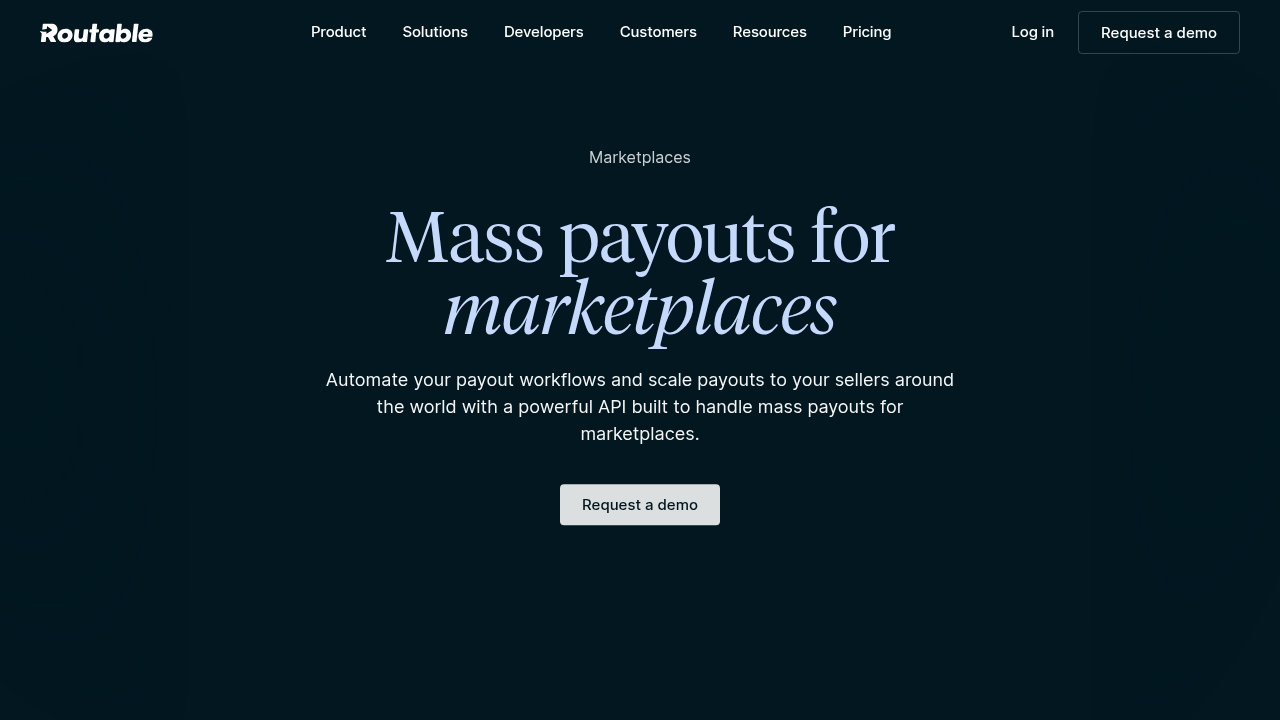
We built Routable specifically for high-velocity marketplaces and gig economy apps where the payout is part of the product. When you need to send funds to thousands of sellers, drivers, or creators, adding finance headcount is not a viable strategy. You need infrastructure that scales automatically with your transaction volume.
Our approach is API-first. Your engineering team can integrate our system in under five minutes and typically complete a full deployment in less than three developer days. This allows you to embed mass payouts directly into your application logic, triggering disbursements instantly when a service is completed or a sale is finalized.
Key Capabilities:
-
Process 10,000+ monthly payments without adding headcount.
-
Process domestic and international payments in one unified system.
-
Send thousands of payments in a few clicks using no-code CSV upload or developer-friendly API.
-
Real-time payment status tracking from initiation to receipt.
Bottom Line:
Routable combines developer-friendly API infrastructure with comprehensive tax compliance and payee management in a single solution purpose-built for mass payouts to sellers, creators, drivers, and gig workers.
Stripe Connect
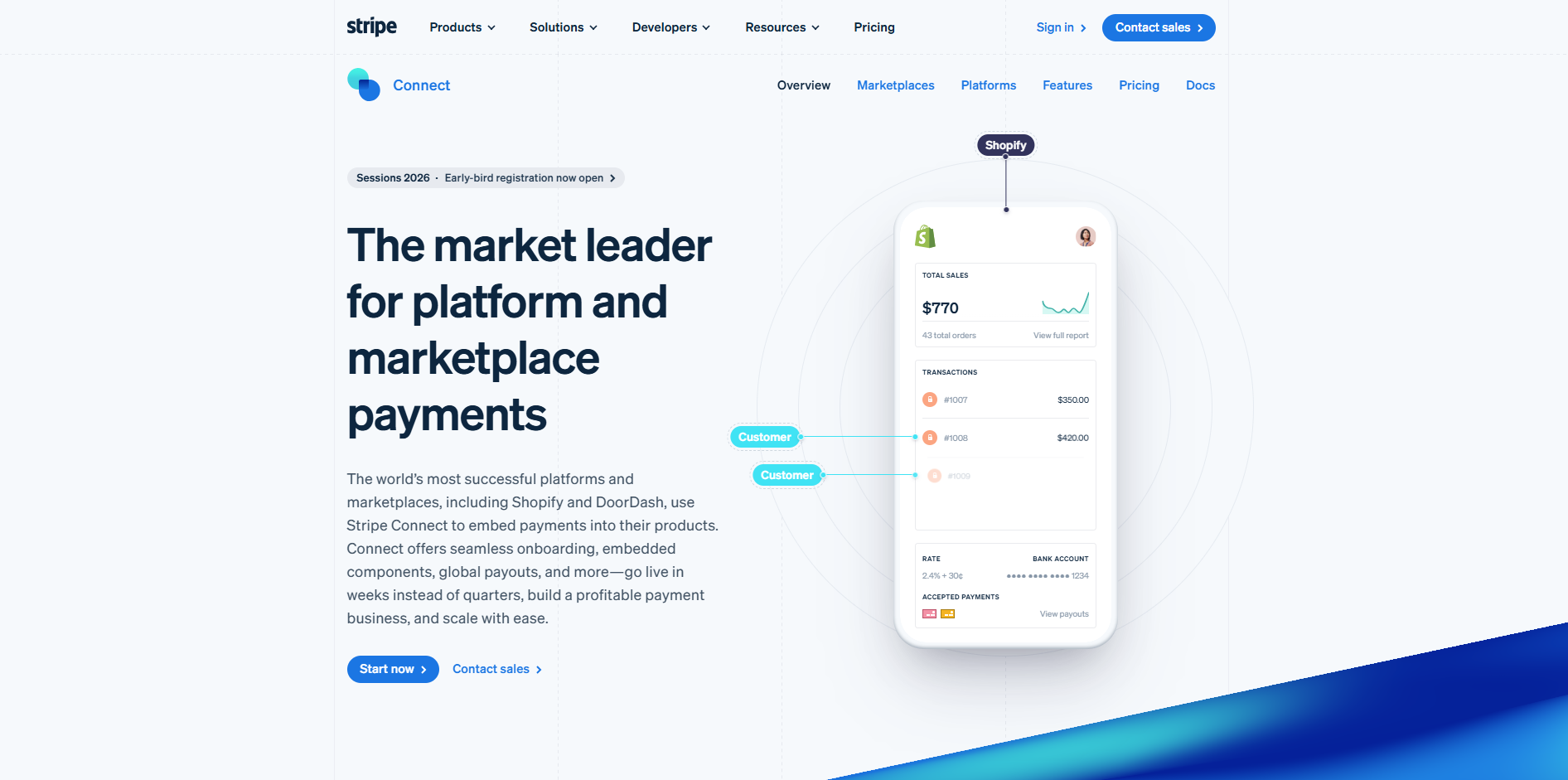
Stripe Connect acts as the specialized marketplace infrastructure layer on top of Stripe’s core processing engine. For many businesses, this is the logical next step: if you use Stripe to accept funds from buyers, Connect allows you to programmatically route those funds to your sellers. It is designed to handle multi-party transactions, automated commission splitting, and the regulatory burden of onboarding merchants.
Key Capabilities:
-
Automatically divides a single customer charge between your commission and the seller’s earnings.
-
Supports payouts to sellers in over 40 countries.
-
Offers Standard, Express, and Custom account types, giving you varying degrees of control over the user interface and compliance liability.
-
Built-in KYC checks and dashboarding tools for sellers to track their earnings.
Limitations:
The cost of consolidation is high. Users face a fee structure involving monthly active account fees plus per-payout costs, which can become expensive for high-volume, low-ticket marketplaces. It also lacks native, direct integrations with major ERPs like NetSuite or Sage Intacct, forcing finance teams to rely on third-party middleware for reconciliation.
Bottom Line:
Stripe Connect works well for marketplaces looking for a unified payment infrastructure, but Routable offers superior accounting integration, more flexible domestic payment rails, and better international FX rates for operators focused on optimizing the full payout workflow.
Hyperwallet
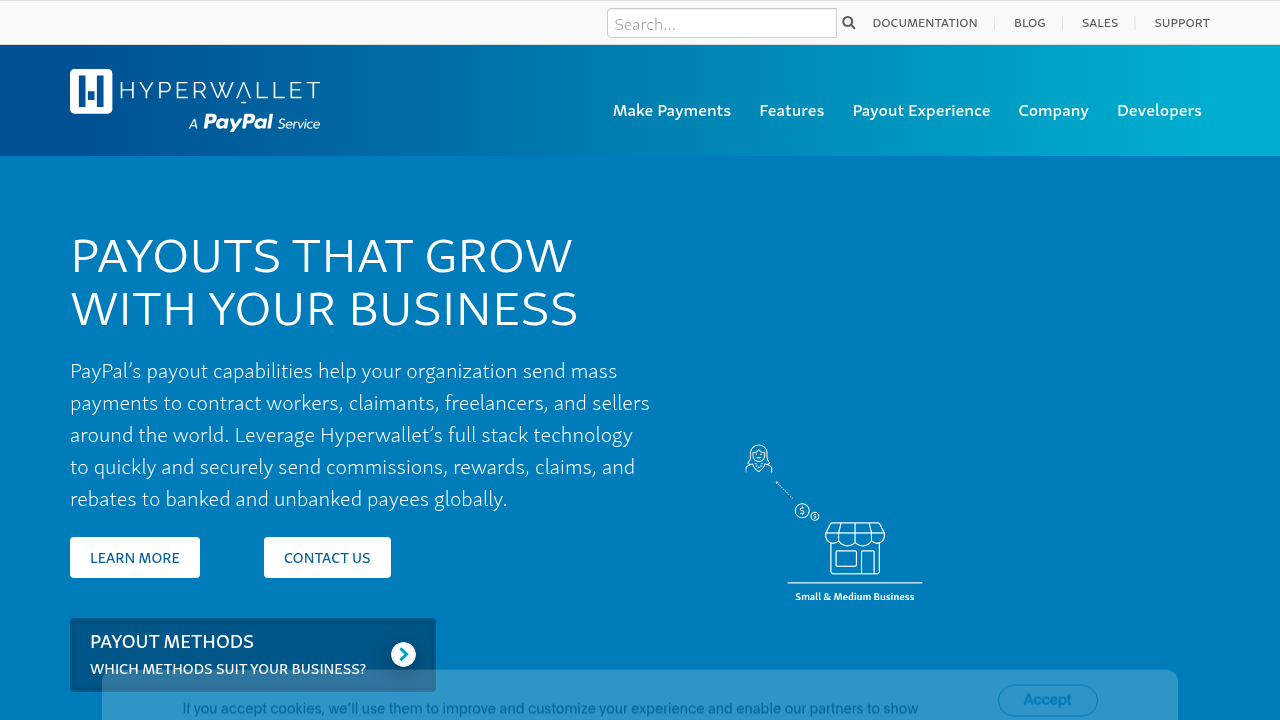
Hyperwallet, acquired by PayPal, focuses on global payout infrastructure and has historically served large enterprise marketplaces. This solution emphasizes international disbursement coverage, leveraging PayPal’s banking network to provide local payment methods across the globe. It is often a go-to choice for massive organizations that need to push funds to a highly distributed, international user base where specific local payout methods are required.
Key Capabilities:
-
Global payout coverage that includes local bank transfers to ensure sellers in different regions can access funds easily.
-
Prepaid card issuance (both physical and virtual) and digital wallet options, which appeal to unbanked gig workers.
-
Mass payment processing capabilities designed to handle high-volume batches across borders.
-
Payee tax form collection to help manage the compliance requirements of a distributed workforce.
Limitations:
The setup and implementation process is complex, often requiring engineering resources and long lead times compared to API-first alternatives. The developer documentation is less comprehensive, which can slow down integration. It lacks native bi-directional ERP integrations, forcing finance teams to perform manual file exports and reconciliation work at month-end. The enterprise-only pricing model also makes it less accessible for mid-market operators.
Bottom Line:
Hyperwallet serves enterprise-scale international disbursements well, but Routable delivers faster implementation, better developer experience, native accounting integrations, and a transparent pricing model better suited for high-growth marketplaces.
Checkbook
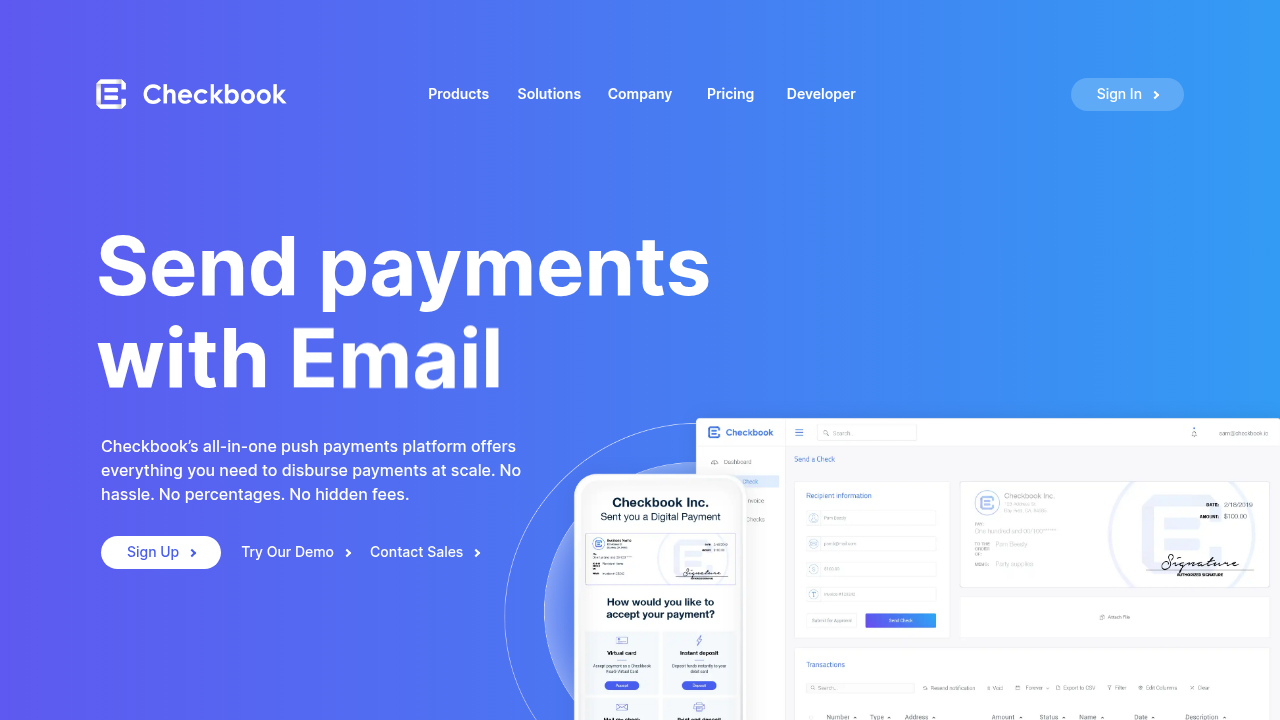
Checkbook provides a single API focused on enabling digital check and ACH disbursements. The solution eliminates physical paper checks by delivering them digitally via email, making it easier for businesses to modernize their payout workflows without overhauling their entire infrastructure.
Key Capabilities:
-
Send real-time payments directly to bank accounts through eligible debit cards via a simple API call.
-
Recipients receive checks via email and do not need to create an account, download an app, or share sensitive bank account information to access funds.
-
Teams can manage payouts through both a web dashboard and developer-friendly API.
-
Flexible payment scheduling with the ability to send one-time or recurring payments on custom schedules.
Limitations:
High-growth marketplaces will likely struggle with default sending limits of only $2,000 per day or $15,000 per month, which require manual requests to increase. The software lacks native ERP integrations, forcing finance teams to handle data synchronization manually. Checkbook also does not support international payments, limiting its utility for global networks compared to more comprehensive providers.
Bottom Line:
Checkbook handles basic digital check and ACH needs for smaller operations, but Routable provides the payment rail flexibility, international coverage, automated tax compliance, and accounting integrations that scaling marketplaces require.
Trolley
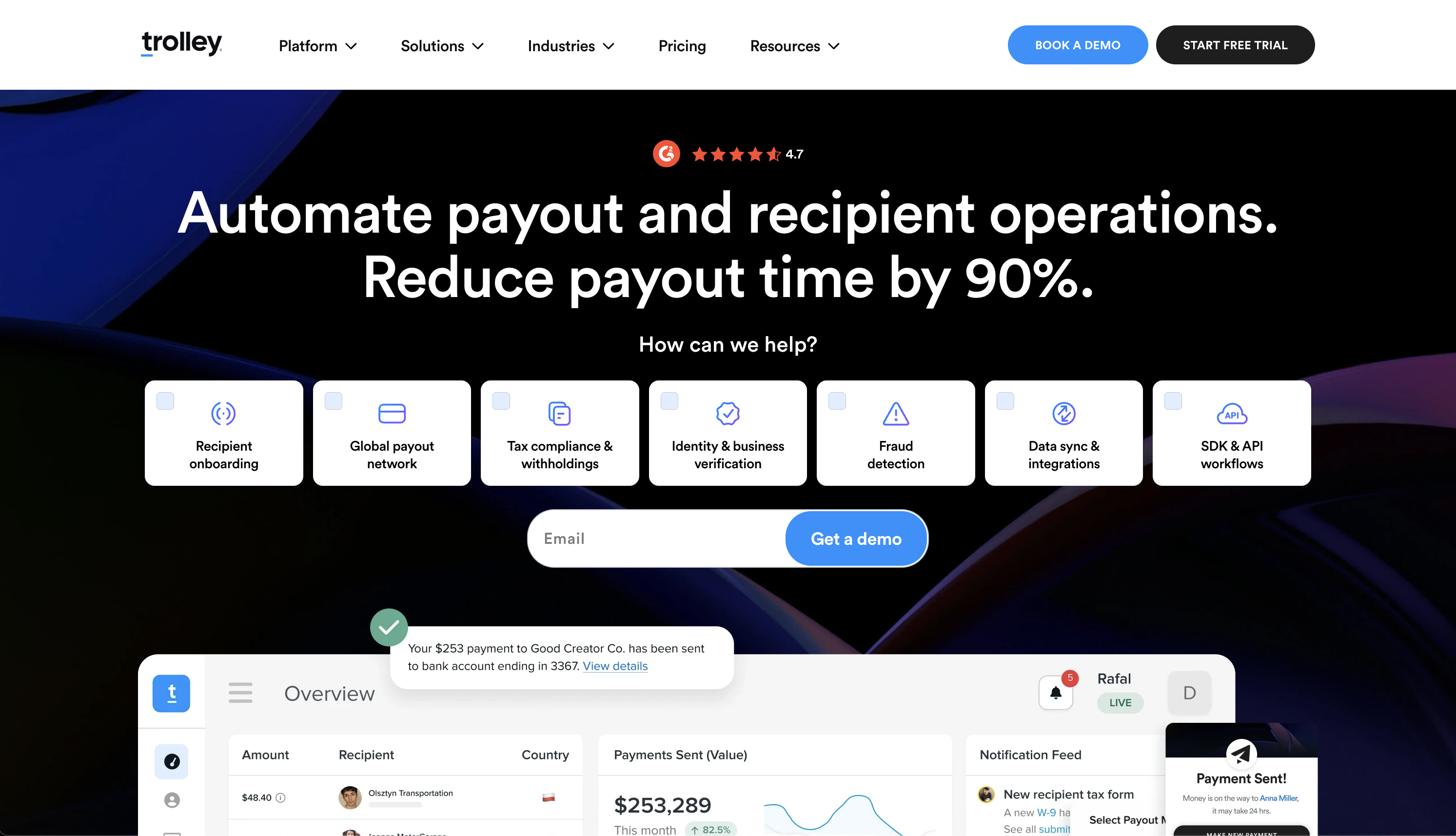
Trolley positions itself as an end-to-end payout system built specifically for the internet economy. It helps businesses manage disbursements, tax compliance, and identity verification for contractors worldwide. The solution is particularly strong for companies in the creator economy, royalties, and music industries that manage a highly distributed global workforce.
Key Capabilities:
-
Processes payouts to over 210 countries and territories.
-
Handles multi-jurisdiction tax requirements, covering both IRS regulations for the US and DAC7 reporting for 27 EU member states.
-
Offers multiple ways to trigger payments, including API, dashboard, or CSV uploads.
-
Provides white-label recipient onboarding to maintain your brand identity during data collection.
Limitations:
While strong globally, the solution offers a smaller selection of payment rails for domestic needs. It lacks Same Day ACH or Real-Time Payments (RTP) options, which limits payout speed for US-based workers. It does not offer a direct integration with NetSuite, often requiring finance teams to invest in custom development work to handle reconciliation.
Bottom Line:
Trolley excels at international creator and royalty payouts with strong EU compliance, but Routable offers superior domestic payment rail options, native ERP integrations, and faster US disbursement speeds critical for gig economy and logistics marketplaces.
BILL

BILL (formerly Bill.com) serves as a dominant solution for traditional accounts payable automation. With its acquisition of Divvy, the company expanded into expense management and corporate cards, establishing itself as a financial hub for small to mid-sized businesses. Its primary utility lies in simplifying the back-office process of receiving, approving, and paying standard vendor invoices.
Key Capabilities:
-
Connects with major accounting systems including QuickBooks, Xero, NetSuite, and Sage Intacct.
-
Powers payments to over 130 countries for international vendor management.
-
Standardizes the approval process for internal finance teams before funds are released.
-
Includes virtual and physical corporate cards through its Divvy product line.
Limitations:
This system is designed for accounts payable invoice processing rather than high-volume programmatic disbursements. It lacks the API-first architecture necessary to embed payout flows directly into a marketplace product. It also does not offer the payee-facing onboarding portals or self-service payment preference collection that sellers and creators require.
Bottom Line:
BILL solves invoice-based AP automation for traditional businesses, but Routable is purpose-built for the API-driven, high-volume, payee-experience-focused requirements of marketplaces, gig platforms, and creator economy operators.
Tipalti
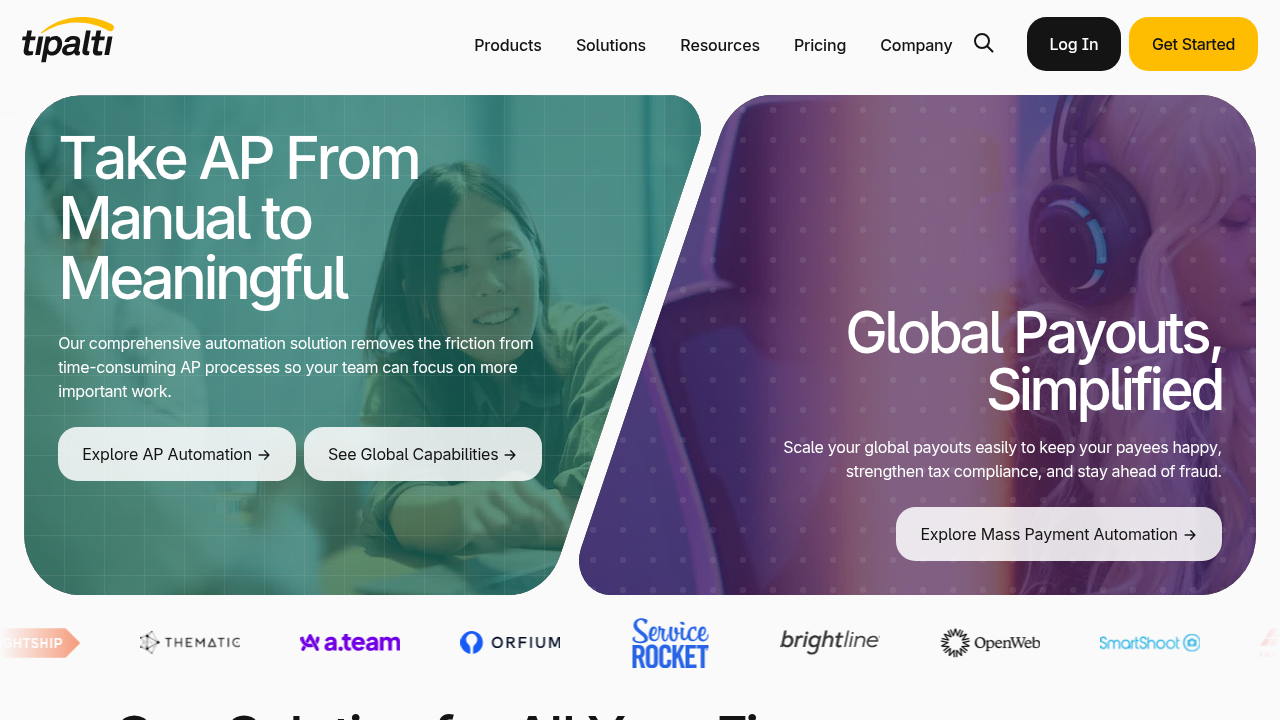
Tipalti serves as an accounts payable automation solution that has expanded to include mass payment capabilities. It primarily targets mid-market and enterprise organizations that need to manage complex supplier relationships and traditional invoices alongside their marketplace disbursements. The system helps finance teams centralize these varied funding flows into one operation.
Key Capabilities:
-
Global payment coverage across 196 countries with support for multiple local payment methods.
-
Payment execution via ACH, wire, check, and international rails.
-
Supplier onboarding portal that collects tax forms, banking details, and compliance documentation.
-
ERP integration with NetSuite, Intacct, and other enterprise accounting systems.
Limitations:
The enterprise focus results in expensive pricing and implementation timelines that often stretch into months. Because the architecture is rooted in traditional AP, creating a branded payee experience often requires customization. The system also lacks support for domestic instant options like Same Day ACH and Real-Time Payments (RTP).
Bottom line:
Tipalti serves enterprise AP departments with mixed invoice and payout needs, but Routable delivers faster implementation, better API developer experience, more flexible domestic payment rails, and superior payee onboarding flows purpose-built for marketplace operators.
Feature Comparison of Mass Payout Platforms
Marketplace operators need to weigh speed against compliance and integration capabilities when selecting infrastructure. The table below compares the seven leading platforms across critical requirements, from domestic payment rails to global reach and implementation speed.
Why Routable is the Best Mass Payout Solution for Marketplaces
Marketplace architecture requires more than just moving money; it demands a unified infrastructure that handles speed, borders, and regulation simultaneously. Routable stands out as the only solution offering a sub-5-minute integration API that connects you to four distinct ACH speeds, Real-Time Payments, and global rails while automating tax compliance. This combination allows engineering teams to build complex payout logic without being slowed down by regulatory hurdles or banking limitations.
For two-sided networks, the payment experience is a competitive product feature rather than just a back-office function. With the gig economy continuing to expand, retaining top talent depends heavily on financial trust and payment speed. Research indicates that workers prefer faster access to earnings, making instant disbursements a critical tool for minimizing churn. Routable’s white-label onboarding and instant notifications ensure your sellers feel valued and informed at every step.
High-growth operators choose Routable to remove the operational ceiling on their transaction volume. We allow you to scale from thousands to tens of thousands of payouts without adding finance headcount, ensuring your system grows as fast as your user base.
Final Thoughts on Mass Payout Solutions for Two-Sided Marketplaces
Two-sided marketplace payments require infrastructure that handles speed, compliance, and scale simultaneously. Your sellers will leave if they can get paid faster somewhere else. Routable combines instant payment rails, automated tax forms, and bi-directional ERP sync in one API-first solution. You get the developer experience and payout speed that high-growth operators need without the enterprise implementation timelines.
FAQ
Which mass payout platform is best for marketplaces with international sellers?
Routable supports payouts to 220+ countries in 140+ currencies with 30-50% savings on FX rates, while Hyperwallet and Trolley also offer strong global coverage. Choose based on whether you need native ERP integrations (Routable) or specialized EU tax compliance like DAC7 (Trolley).
How do I choose between an API-first solution and a traditional AP tool?
If you’re processing high-volume programmatic disbursements to sellers, creators, or gig workers, choose an API-first platform like Routable or Stripe Connect. Traditional AP tools like BILL work better for invoice-based vendor payments but lack the payee onboarding and real-time payment rails that marketplace operators need.
What’s the fastest way to get sellers paid in the US?
Real-Time Payments (RTP/FedNow) deliver funds instantly 24/7/365, followed by Same Day ACH (arrives by 6pm ET) and Push-to-Card options. Routable offers all three, while most competitors lack RTP support or limit you to slower ACH speeds.
Can I automate tax compliance for thousands of payees?
Yes. Platforms like Routable, Stripe Connect, and Tipalti automatically collect W-8/W-9 forms during onboarding and handle 1099 and 1042-S filing. This removes the manual burden from your operations team as you scale your payee network.
How long does implementation take for a mass payout API?
Implementation speed varies widely: Routable integrates in under 3 developer days, Checkbook takes days to weeks, while enterprise solutions like Hyperwallet and Tipalti often require months. Choose based on your engineering resources and time-to-market requirements.