Traditional tax software breaks down fast when managing contractor tax compliance at scale. When you’re processing thousands of monthly payouts to gig workers, creators, or sellers, you can’t chase W-9s manually or reconcile payment data through spreadsheets without creating compliance risks. This guide compares the platforms purpose-built for high-volume businesses. These high-volume businesses require W-9 collection, TIN validation, and IRS filing integrated directly into their payout workflows, not bolted on as an afterthought.
TLDR:
- Automated W-9 collection during payee onboarding prevents year-end compliance scrambles.
- Real-time TIN validation catches IRS mismatches before filing deadlines hit.
- API-first platforms handle 1099-NEC, 1099-MISC, and 1042-S filing at scale without spreadsheets.
- Routable combines tax automation with mass payout infrastructure for high-volume contractor payments.
What is 1099 Automation?
1099 automation consolidates W-9 collection, TIN validation, payment tracking, and IRS filing into a single workflow. Instead of chasing down tax forms manually or reconciling spreadsheets at year-end, you collect compliance data during payee onboarding and let the system track thresholds automatically.
This matters for high-volume operators paying thousands of gig workers, creators, sellers, or service providers. When you’re processing mass payouts through API or CSV uploads, you need tax compliance that scales with your disbursement volume. 1099 automation ensures every contractor payment is tracked, validated against IRS records, and filed correctly without adding headcount to your ops team.
How We Ranked 1099 Automation Platforms
We evaluated each solution based on how well it handles contractor tax compliance at scale. Traditional 1099 software is built for small business owners filing a handful of forms. These criteria reflect what matters when you’re managing thousands of payee relationships through programmatic disbursements.
We ranked based on five factors:
- Automated W-9 and W-9 collection integrated directly into payee onboarding workflows.
- Real-time TIN validation against IRS records to catch errors before filing deadlines.
- Support for 1099-NEC, 1099-MISC, 1099-K, and 1042-S filing at volume.
- API capabilities that enable programmatic tax data management alongside payment processing.
- Integration with mass payout workflows, including CSV uploads and batch disbursements.
Best Overall 1099 Automation Solution: Routable
Routable combines automated 1099 filing with mass payout infrastructure designed for high-volume contractor payments. Where traditional tax software treats compliance as a separate year-end task, we built tax collection into the same API and CSV workflows you use to process thousands of payouts each month.
Key Capabilities:
- Automated W-8/W-9 collection during payee onboarding to capture tax documentation before first payment.
- Real-time TIN validation against IRS records to catch name mismatches and invalid tax IDs preemptively
- API-first 1099 automation integrates tax compliance directly into mass payout workflows with idempotency keys and 14 webhook events.
- Multi-form support (1099-NEC, 1099-MISC, 1099-K, 1042-S) handles domestic contractors, international payees, and payment processor scenarios in one system.
Bottom Line:
Routable delivers the only solution that combines W-8/W-9 collection, real-time TIN validation, multi-form 1099 filing (NEC, MISC, K, 1042-S), and mass payout infrastructure in a single API-first platform. If you’re processing contractor payments through CSV uploads or API integration across multiple rails—ACH, checks, international wires—you need tax compliance that scales with your disbursement volume without adding ops headcount. Traditional 1099 software treats tax filing as a separate year-end task; we built it into your payment workflow from day one.
Stripe Connect
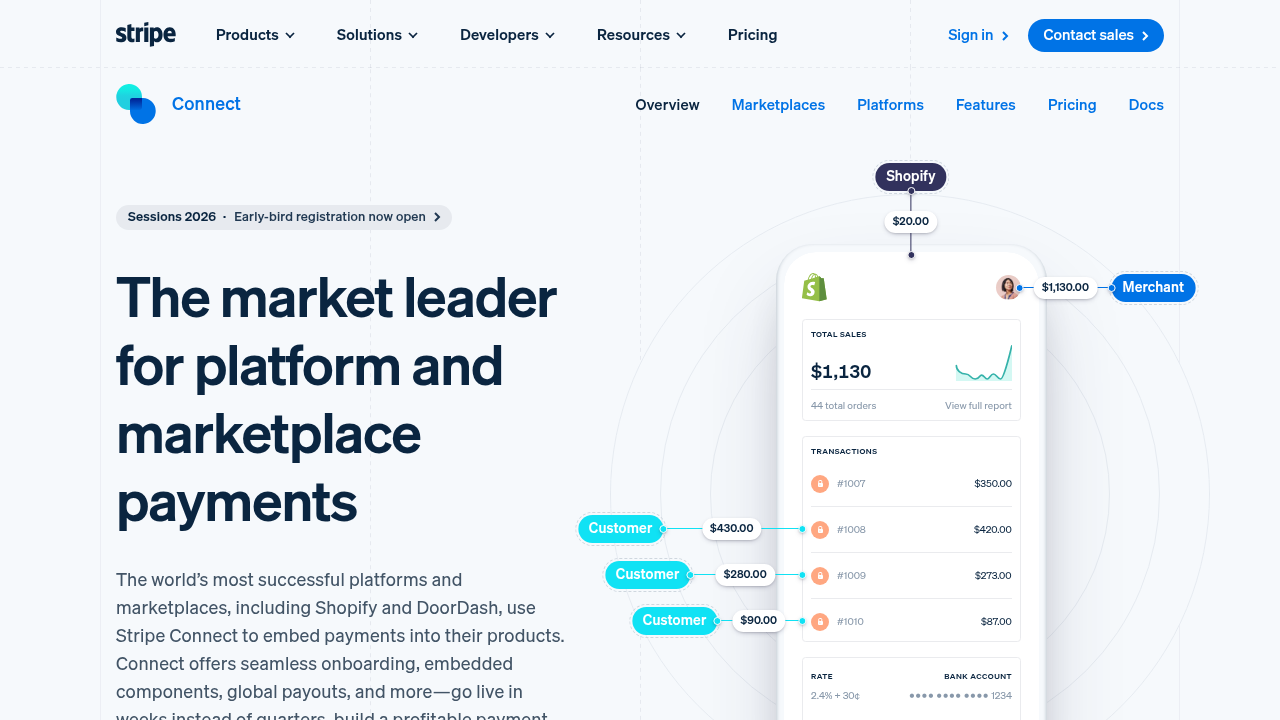
Stripe Connect provides payment infrastructure for marketplaces with built-in 1099-K filing for payment processors. If you’re running a two-sided marketplace where sellers receive payments through your system, Stripe handles the payment facilitator compliance requirements automatically.
Key Capabilities:
- Connected account model that creates separate Stripe accounts for each seller on your marketplace.
- The API handles KYC and identity verification during seller onboarding, collecting the tax information needed for 1099-K reporting.
- Automatic threshold tracking monitors seller payment volumes and triggers 1099-K when thresholds are met.
- Developer-friendly API follows standard Stripe patterns with extensive documentation for marketplace processing
Limitations:
Does not support 1099-NEC or 1099-MISC filing for service contractors, lacks W-9 collection automation for non-payment-processor scenarios, provides minimal support for check payments or ACH disbursements outside card networks, and cannot handle 1042-S filing for international contractors requiring W-8 forms.
Bottom Line:
Stripe Connect works well for payment facilitators needing 1099-K automation, but businesses managing contractor service payments across multiple rails including checks, ACH, and international wires require Routable’s comprehensive 1099-NEC and 1099-MISC automation with full W-9 and W-8 workflow support.
Tipalti
Tipalti provides AP automation with global tax compliance features for finance teams. Their system combines invoice processing with contractor payment capabilities, targeting businesses that handle both traditional vendor bills and service provider payments.
Key Capabilities:
- Tipalti collects W-8 and W-9 series forms during supplier onboarding for domestic and international contractors.
- Multi-currency payment processing handles international rails with 1042-S preparation and filing for foreign payees.
- Invoice capture and PO matching combines traditional AP workflows with contractor payment capabilities.
- 1099 and 1042-preparation automates year-end tax filing for service providers and international contractors.
Limitations:
Uses outdated SOAP API for payee management instead of REST, lacks idempotency keys for preventing duplicate payments during network failures, does not support embedded vendor onboarding components for white-label payee experiences, and provides no receivables functionality or approval workflows via API.
Bottom Line:
Tipalti serves traditional AP use cases but lacks the API-first architecture and payee experience focus required by high-volume tech operators, while Routable provides real-time REST API with idempotency, embedded onboarding, and product-integrated payout workflows built specifically for programmatic mass payments.
Trolley
Trolley offers global payout infrastructure with W-9 and W-8 tax form collection. Their focus is cross-border disbursements with tax compliance built into the payee workflow, targeting businesses managing international contractor networks at scale.
Key Capabilities:
- Trolley automates W-8 and W-9 form capture during payee onboarding.
- Handles 1099 and 1042-S IRS filing for domestic and international contractors.
- Global payment coverage spans 210+ countries with local rail support.
- Compliance dashboard provides visibility into tax reporting status across contractor base.
Limitations:
Requires minimum of 100 payments per month which excludes smaller operations, lacks idempotency key support allowing duplicate payment creation during network errors, provides limited ERP integration options for ledger synchronization, and offers minimal approval workflow controls for multi-entity or complex organizational structures.
Bottom Line:
Trolley handles international tax compliance but imposes volume minimums and lacks the flexibility needed for mixed domestic and international payout scenarios, while Routable supports any volume with no minimums, offers full idempotency protection, and provides robust approval workflows and ERP sync.
Hyperwallet
Hyperwallet operates PayPal’s mass payout network for creator and gig economy disbursements. The system targets consumer-facing operations where PayPal serves as a primary payout method for freelancers, influencers, and gig workers.
Key Capabilities:
- Provides drop-in UI components that embed payout experiences into the application.
- Supports multiple disbursement methods including PayPal transfers, push-to-card, and prepaid options.
- Global coverage spans 200+ countries with local currency support.
- Handles 1099 filing for U.S. contractors who meet reporting thresholds.
Limitations:
Payee experience lives entirely within PayPal ecosystem rather than under your brand, provides minimal control over compliance holds or ledger reconciliation processes, lacks idempotency key support for preventing duplicate payment creation, and offers limited flexibility for mixed payment methods outside the PayPal network.
Bottom Line:
Hyperwallet works for PayPal-centric payout scenarios but forces payees into the PayPal ecosystem, while Routable provides fully white-labeled custom-branded onboarding and notifications that keep payees in your product experience with complete compliance control.
BILL

BILL provides AP automation with basic 1099 filing for traditional vendor payments. Their system focuses on invoice processing and bill pay workflows, targeting small businesses that primarily manage vendor invoices with occasional contractor payments.
Key Capabilities:
- BILL automates invoice capture and approval workflows for traditional accounts payable scenarios.
- Generates 1099-NEC and 1099-MISC forms for domestic service contractors.
- Processes vendor payments via ACH and check rails.
- Integrations with QuickBooks and other accounting software handle ledger synchronization for small business finance teams.
Limitations:
Provides no webhook support for real-time payment status notifications, lacks comprehensive international tax collection for W-8 forms and 1042-S filing, offers limited SWIFT support across fewer countries than alternatives, and does not support automatic currency conversion for multi-currency contractors.
Bottom Line:
BILL handles basic AP and simple 1099 filing but lacks the webhook infrastructure, international tax support, and global payment coverage required by high-volume tech operators, while Routable delivers 14 webhook events, W-8 and 1042-S automation, and SWIFT across 220+ countries.
Checkbook
Checkbook provides push-payment API with ACH and virtual card disbursements. Their system targets developers building simple payout features without needing compliance infrastructure or vendor management tools.
Key Capabilities:
- Offers straightforward API integration for ACH and digital check payments.
- Push-to-card and virtual card options support basic disbursement scenarios.
- Sandbox testing with Postman support makes initial integration quick for engineering teams.
- Digital check delivery via email, SMS, or physical mail provides flexible disbursement options for payees without bank accounts.
Limitations:
Provides no tax form collection or TIN validation capabilities, lacks 1099 preparation and filing infrastructure entirely, offers no idempotency key support allowing duplicate payment creation during failures, and includes minimal vendor management or issue resolution tools.
Bottom Line:
Checkbook handles basic payment transmission but provides zero tax compliance infrastructure, while Routable delivers full W-9 collection, TIN validation, 1099 filing, and deep ERP connectivity purpose-built for operations at scale.
Feature Comparison Table of 1099 Automation Platforms
The table below compares core 1099 automation capabilities across seven solutions. IRS TIN matching failures remain a leading cause of filing errors, making real-time validation critical. Filing penalties escalate quickly, especially when you’re managing the 73.3 million gig workers expected in the U.S. economy by year-end.
Why Routable is the Best 1099 Automation Solution
We built 1099 automation specifically for tech operators managing mass payouts to creators, gig workers, and sellers at scale. IRS penalties range from $60 to $340 per form depending on filing delays, and with 76.4 million U.S. freelancers accounting for 36% of the workforce in 2025, manual tax processes create exponential compliance risk.
Our approach treats contractor tax compliance as payment infrastructure rather than a separate finance task. We validate TIN accuracy against IRS records during payee onboarding, catching errors before they become filing problems. Our REST API with idempotency keys and 14 webhook events lets you build compliant contractor payments directly into your product experience without adding ops headcount or introducing payout delays.
If you’re processing thousands of monthly disbursements through API or CSV workflows, you need tax automation that scales with your payout volume. Schedule a demo to see how we handle W-9 collection, threshold tracking, and IRS filing for high-volume contractor networks.
Final Thoughts on Scaling Contractor Tax Compliance
W-9 collection automation and real-time TIN validation become critical once you’re paying hundreds of creators, drivers, or sellers each month. Manual tax processes don’t scale with programmatic disbursements. The right system treats 1099 filing as payment infrastructure, not a separate finance task. Your compliance workflows should match the speed and volume of your payout operations.
FAQ
How do I choose the right 1099 automation platform for my business?
Start by evaluating your payout volume and payment methods. If you’re processing thousands of monthly contractor payments through API or CSV uploads across multiple rails (ACH, checks, international wires), you need a solution like Routable that integrates tax compliance directly into mass payout workflows. If you only facilitate card transactions as a payment processor, Stripe Connect’s 1099-K-only approach may suffice.
Which 1099 automation solution works best for international contractor payments?
Routable handles both W-9 collection for domestic contractors and W-8 series forms for international payees, with automated 1042-S filing across 220+ countries. Trolley also supports international tax compliance but requires 100+ monthly payments minimum. BILL and Checkbook lack W-8 and 1042-S capabilities entirely.
Can I automate 1099 filing if I’m using CSV uploads instead of API integration?
Yes. Routable processes bulk contractor payments through CSV file uploads with automatic tax compliance checks built in. The system flags missing W-9 documentation before processing disbursements and tracks payment thresholds throughout the year without requiring API development resources.
What’s the difference between 1099-NEC, 1099-MISC, and 1099-K filing requirements?
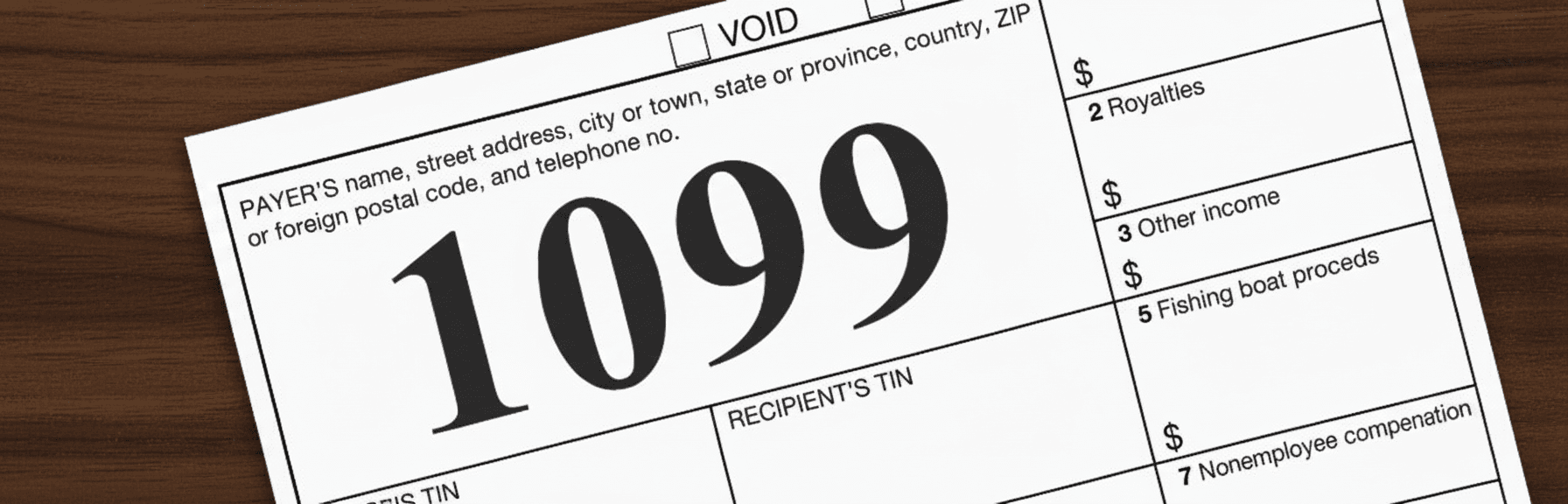
1099-NEC reports nonemployee compensation for service contractors (freelancers, gig workers, creators). 1099-MISC covers rent, royalties, and other income types. 1099-K applies when you act as a payment processor facilitating third-party transactions. Routable automatically identifies which form each payee requires based on payment type and your business model.
When should I switch from manual 1099 preparation to automated filing?
If you’re managing more than 50 contractor relationships or processing payments through API or batch uploads, manual tax form collection creates compliance risk. Real-time TIN validation during payee onboarding prevents year-end filing errors, and automated threshold tracking eliminates spreadsheet reconciliation as your contractor network scales.