

Standard payment tools break down when you send grants to unsupported regions with volatile currencies. Grantees can’t complete onboarding, FX rates eat into grant amounts, and your team drowns in manual compliance checks. International grantee payment platforms solve these problems. With API-driven workflows, CSV batch processing, lower fees, multi-currency support, and built-in compliance screening, these platforms let organizations scale grant distributions from hundreds to thousands of monthly disbursements without adding headcount. In this guide, we break down the top platforms helping nonprofits execute high-volume international payouts efficiently and transparently.
TLDR:
- Scale from manual bank portal payouts to automated batch disbursements reaching 220+ countries and 140+ currencies through local banking rails and API-driven execution.
- Cut FX costs by 30-50% compared to traditional banks while showing grantees exactly what they’ll receive after conversion before you send funds.
- Automate compliance screening against OFAC and global watchlists, collect W-8/W-9 tax forms through self-service onboarding, and maintain audit trails without manual data entry.
- Execute mass disbursements via CSV upload for immediate needs or API integration for webhook-driven automation when grant management systems trigger approved payouts.
- Choose Routable for unified domestic and cross-border mass disbursements with idempotency-protected APIs, batch CSV processing, and custom payment routing during regional banking disruptions.
What Are International Grantee Payment Platforms?
International grantee payment platforms help nonprofits execute mass disbursements to recipients worldwide through API-first infrastructure or no-code CSV uploads. These systems handle cross-border payments at scale while managing compliance requirements across jurisdictions.
Standard payment rails fall short when distributing funds to thousands of grantees across continents. Manual bank portal workflows break down around 1,000 monthly disbursements. You need coverage for unsupported regions, transparent FX rates that preserve grant amounts, and onboarding flows that work whether you’re paying journalists in South Asia or community organizers in West Africa.
These platforms handle programmatic disbursement needs: processing batch payments via CSV upload or API calls, syncing payment status through webhooks, screening recipients against global watchlists, and collecting tax documentation by jurisdiction. They give your ops team and grantees real-time visibility into payment status and post-conversion amounts without forcing finance staff into bank portals for each disbursement.
Key Features of International Grantee Payment Platforms
International grantee payment platforms deliver specialized capabilities for high-volume grant disbursement workflows. These features help you assess which solution fits your mass-payout requirements.
Global Payment Coverage and Currency Support
Coverage determines whether a platform can reach grantees in your target regions at scale. The strongest solutions support 140+ currencies and process payments to 200+ countries through local banking rails, SWIFT networks, and alternative payment methods. Local rail access reduces transfer fees and speeds arrival times compared to traditional wire transfers. This matters when you’re executing recurring disbursement cycles to thousands of recipients.
Compliance and Recipient Screening
Grant compliance at scale requires automated watchlist screening against OFAC, EU sanctions lists, and other regulatory databases. Platforms should validate tax identification numbers, collect W-9 forms for U.S. recipients and W-8 series forms for international grantees, and maintain audit trails that meet nonprofit accounting standards. These automated controls reduce risk when you’re processing batch disbursements across jurisdictions with different regulatory requirements, without manual review bottlenecks.
Grantee Onboarding and Payment Preferences
Self-service onboarding collects banking details, tax documentation, and payment preferences without manual data entry by ops staff. White-label capabilities maintain brand consistency during the onboarding flow. Platforms should support multiple payment methods per grantee and let recipients update banking information securely. This becomes critical when onboarding thousands of new grantees monthly.
Transparent Foreign Exchange and Fees
FX transparency shows grantees exactly what they’ll receive after currency conversion before you execute the batch disbursement. Competitive platforms offer exchange rates 30-50% better than traditional banks. Transparent fee structures prevent hidden conversion costs or intermediary bank charges from reducing grant amounts when you’re distributing funds to hundreds of recipients per payment cycle.
Batch Processing and API Access
Batch payment capabilities let you process hundreds or thousands of disbursements simultaneously through CSV upload for immediate needs. API access supports webhook-driven automation with idempotency protection triggered by grant management systems or approval processes. Real-time status updates through webhooks eliminate manual payment tracking when executing recurring disbursement cycles.
Best Overall International Grantee Payment Solution: Routable
Routable delivers mass disbursements to recipients in 220+ countries across 140+ currencies, with API-first infrastructure for organizations running automated grant workflows and CSV uploads for teams processing immediate payment batches.
Key capabilities include bidirectional sync with NetSuite and Sage Intacct for fund accounting accuracy, white-label grantee onboarding that collects W-8/W-9 tax forms and bank details, real-time payment tracking with webhook notifications for status updates, and FX rates 30 to 50 percent better than competitors.
Routable works best for nonprofits managing international grant portfolios that need to scale from hundreds to thousands of monthly disbursements without adding ops headcount or managing multiple payment vendors. CSV batch processing handles immediate payment needs while API infrastructure supports webhook-driven automation as grant programs mature.
Tipalti
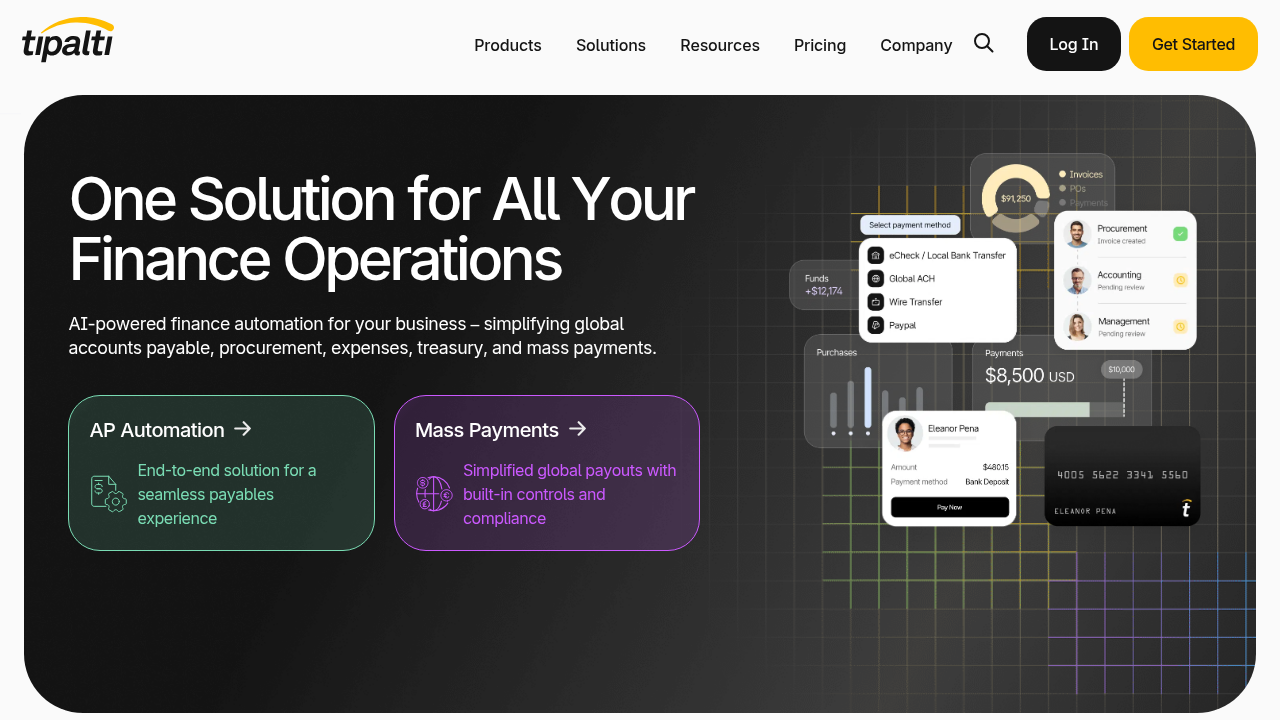
Tipalti provides mass payout infrastructure with global payment coverage and tax compliance automation for finance teams executing high-volume disbursements.
The platform supports payments to more than 200 countries in 120 currencies through ACH, wire transfer, PayPal, prepaid debit cards, and local bank transfers. Tipalti provides both REST and legacy SOAP APIs for payee onboarding and payment execution, plus a self-service supplier portal for vendor registration. Automated W-8 and W-9 collection and generation of forms such as 1042-S and 1099 automate tax compliance workflows.
Organizations with enterprise finance teams typically use Tipalti when they need global payee onboarding and tax compliance automation at scale. However, cross-border transactions include FX spreads embedded in exchange rates without upfront transparency. The API relies on client-managed payment reference codes instead of dedicated idempotency keys, requiring implementations to add safeguards preventing duplicate payments during retries.
Stripe Connect
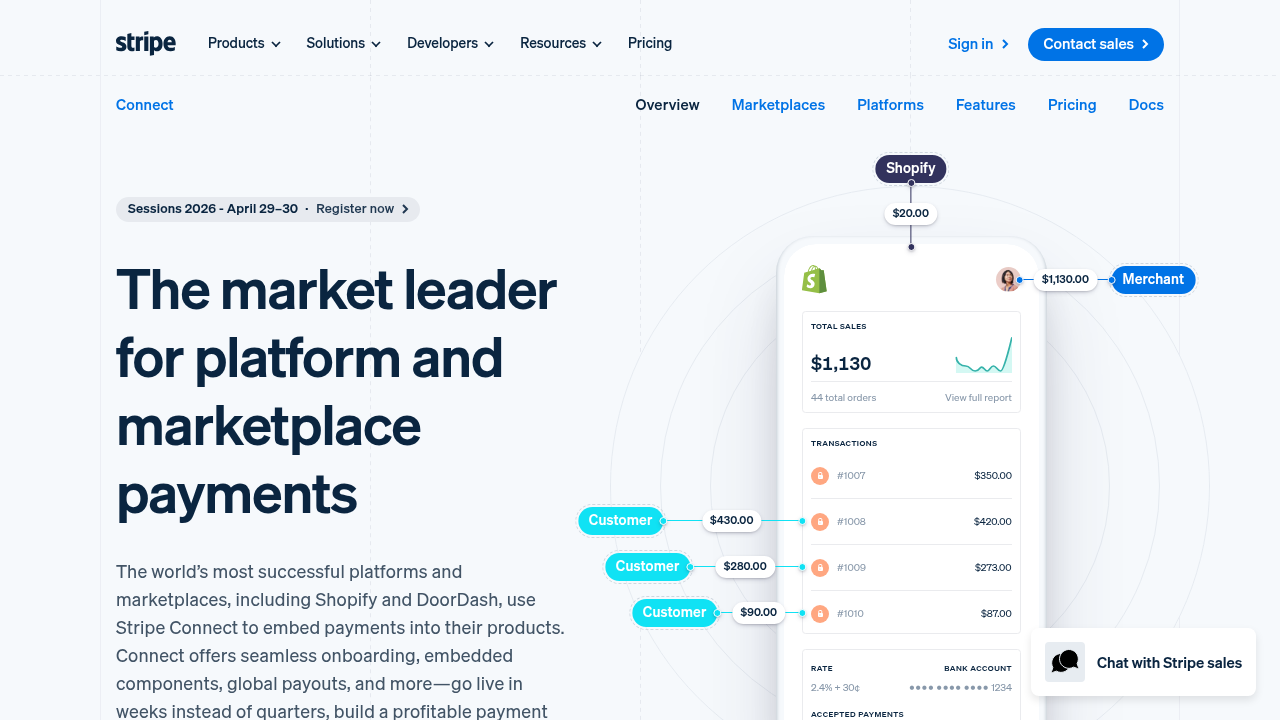
Stripe Connect provides marketplace payout infrastructure with embedded KYC workflows and automated 1099 tax filing. While Stripe excels at payment collection, the platform’s payout capabilities serve marketplace payment flows instead of standalone mass-disbursement infrastructure.
The platform supports payments in 135+ currencies and more than 40 payment methods. You can route funds between multiple parties using destination charges, direct charges, or separate charges and transfers. Built-in capabilities include fraud detection, automated 1099 tax reporting, configurable payout schedules, and optional instant payouts to bank accounts or debit cards.
Software platforms and marketplaces commonly use Stripe Connect when embedding payments directly into their product experience. However, Stripe designed the platform for payment facilitation workflows, not dedicated mass-payout infrastructure for batch disbursements. Pricing is transaction-based with additional fees for instant payouts, international transfers, and currency conversion.
Hyperwallet
Hyperwallet, a PayPal-owned payout platform, provides global mass-payout infrastructure for organizations distributing funds to contractors, sellers, creators, and affiliates at scale. The platform focuses on large-scale payout programs through APIs and hosted payout portals.
The system supports payouts to 200+ countries and territories through bank transfers, prepaid cards, PayPal transfers, and cash pickup options in certain regions. Hyperwallet provides built-in compliance tools like identity verification, tax form collection, and reporting workflows. REST APIs let platforms automate payee registration, payment creation, and payout tracking.
Marketplaces, gig-economy platforms, and global affiliate programs commonly use Hyperwallet when distributing funds to large numbers of recipients across multiple countries. However, the platform operates as a payout orchestration layer instead of a full payment acceptance system. Many implementations rely on hosted payout experiences and managed program setup instead of fully developer-controlled payout infrastructure. FX rates aren’t always transparent upfront, making it difficult to show grantees exact post-conversion amounts before executing disbursements.
Trolley
Trolley provides payout and tax compliance infrastructure for marketplaces, creator platforms, and affiliate networks sending payments to large numbers of global recipients through APIs and hosted payout portals.
The platform supports payouts to 200+ countries and territories through bank transfers, PayPal, prepaid cards, and other local payout options depending on region. Trolley provides built-in tax compliance features like automated W-9 and W-8 collection, generation of U.S. forms like 1099 and 1042-S, and recipient self-service portals for onboarding and payment management.
Digital marketplaces, creator economy platforms, and affiliate networks commonly use Trolley when managing payouts and tax reporting for large contractor or partner networks. However, the system focuses on payout orchestration and compliance instead of payment acceptance infrastructure. FX rates aren’t always transparent upfront, creating uncertainty about post-conversion amounts when executing batch disbursements.
Bill.com
Bill.com provides traditional accounts payable automation focused on invoice management, approval workflows, and payment processing for small to mid-sized businesses. The platform serves invoice-driven AP workflows instead of mass-disbursement use cases.
The system supports payments via ACH, wire transfer, and check, with integrations to accounting systems including QuickBooks, Xero, and NetSuite. Bill.com offers vendor onboarding through a portal where vendors create accounts to receive payments and view payment status. Approval workflows route invoices based on amount thresholds and organizational hierarchies.
Businesses commonly use Bill.com for traditional invoice-driven payment processes. However, international payment capabilities are limited compared to specialized mass-disbursement platforms. Organizations managing grant programs report friction with vendor onboarding timelines, payment speed to recipients, and visibility across multiple entities. The platform’s clearing account model creates reconciliation complexity for organizations processing high-volume batch disbursements. Nonprofits report the system breaks down around 1,000 monthly payments and forces manual workarounds for unsupported countries.
Feature Comparison Table of International Grantee Payment Platforms
Why Routable Is the Best International Grantee Payment Solution
Nonprofits managing international grant programs face a specific scaling challenge: payment infrastructure must handle thousands of monthly disbursements to unsupported regions with transparent FX rates while maintaining fund-level accounting accuracy and compliance screening without adding ops headcount. Following grant management best practices requires payment infrastructure that automates these workflows. Routable solves this without forcing organizations to choose between technical flexibility and practical ease.
Bidirectional NetSuite and Sage Intacct sync preserves custom field structures that tie disbursements to specific programs. CSV upload processes batch payments in minutes for immediate disbursement needs, while webhook-driven automation with idempotency protection supports mature grant management systems triggering approved payouts programmatically.
Grantee onboarding scales across 220+ countries with automatic W-8 collection and watchlist screening, which matters when onboarding thousands of new recipients. The platform shows post-conversion amounts before funds move, so grantees in regions with volatile exchange rates know exactly what arrives. When political disruption blocks standard rails, the team manually creates custom payment paths to maintain disbursements during regional crises. This capability matters for organizations paying journalists or field workers in unstable regions.
Nonprofit news organization Mongabay switched from Bill.com to Routable to pay journalists across 92 countries. Bill.com broke down as their disbursement volume scaled and blocked payments to key coverage regions. Routable resolved payment blocking in regions like South Asia during political crises by creating custom routing when standard banking channels failed, while maintaining real-time parity with their Sage Intacct system. The platform eliminated manual bank portal workflows that couldn’t scale beyond 1,000 monthly disbursements.
Final Thoughts on Selecting Payment Solutions for Global Grants
Most international grantee payment tools force you to rebuild accounting integrations or accept limited country coverage when scaling disbursement volume. You need both: bidirectional ERP sync that respects fund structures and local rail access in regions where your recipients operate, plus API infrastructure or CSV batch processing that handles hundreds to thousands of monthly disbursements without manual bank portal workflows. The table above shows which solutions deliver on those requirements for high-volume international payouts.
FAQs
What should nonprofits look for in an international grantee payment platform?
Nonprofits scaling grant disbursements should focus on batch processing capabilities (CSV upload or API integration), global coverage (200+ countries and 140+ currencies), transparent FX rates showing post-conversion amounts before execution, automated compliance screening against OFAC and sanctions lists, self-service grantee onboarding collecting W-8/W-9 forms, and bidirectional accounting system integration with NetSuite or Sage Intacct to maintain fund-level tracking across thousands of monthly disbursements.
How do international grantee payment platforms handle compliance?
These platforms automate compliance for high-volume disbursements by screening recipients against global watchlists (OFAC, EU sanctions lists), collecting tax documentation (W-9 for U.S. recipients, W-8 series for international grantees), validating tax identification numbers, and maintaining audit trails meeting nonprofit accounting standards. The screening happens during onboarding and before each disbursement batch. This matters when processing thousands of monthly payouts without manual review bottlenecks.
What’s the cost difference between international grantee payment platforms?
Pricing varies by platform architecture and disbursement volume. Solutions like Routable offer transparent monthly fees plus per-transaction costs with FX rates 30-50% better than traditional banks, delivering substantial savings at scale when executing thousands of monthly cross-border disbursements. Platforms like Tipalti embed FX spreads in exchange rates without showing them upfront, making total cost difficult to assess. Bill.com’s limited international capabilities force nonprofits processing high-volume international disbursements to use multiple providers and pay higher wire fees.
Can these platforms integrate with NetSuite or Sage Intacct for fund accounting?
Yes. Routable provides bidirectional sync with both NetSuite and Sage Intacct, preserving custom field structures that tie disbursements to specific programs and funds. This sync maintains fund-level accounting accuracy without manual reconciliation. This is critical when processing hundreds or thousands of monthly grant disbursements. Other platforms like Tipalti offer integrations, but many lack the bidirectional sync needed for nonprofit fund accounting workflows at scale.
How do FX rates compare across international grantee payment platforms?
FX rate transparency and competitiveness vary widely and directly impact total cost when executing thousands of monthly cross-border disbursements. Routable shows the exact post-conversion amount before sending funds and offers rates 30-50% better than competitors; this is critical for preserving grant amounts. Tipalti, Hyperwallet, and Trolley embed FX spreads that aren’t always visible upfront, making it difficult to show grantees exact amounts before executing payment batches. Bill.com’s limited international support forces nonprofits to use bank wires with poor exchange rates and high intermediary fees.
How fast do international grantee payments arrive?
Arrival times depend on the destination country and payment method. Local rail payments typically arrive in 1-3 business days, while SWIFT transfers take 3-5 business days. Platforms with strong local banking relationships (like Routable’s 220+ country coverage) can route batch disbursements more efficiently. During regional crises or banking disruptions, platforms with manual intervention capabilities can create custom payment paths to maintain disbursements. This matters for nonprofits paying field workers or journalists in unstable regions where standard rails fail.