

Your grant system knows exactly when payments should go out, based on milestone approvals, documentation submissions, and compliance checks. But actually executing those disbursements still requires manual intervention through a separate banking portal. This gap between workflow logic and payment execution is why developer-friendly disbursements become critical as you scale. We’re talking about turning grant approvals into API calls that trigger payments automatically, so your application logic directly controls when and how money moves. The following sections break down how this works from an integration standpoint and why it eliminates the bottlenecks you’re dealing with now.
TLDR:
- Embed payments directly into your grant management system via API in under 3 developer days
- Automate tax compliance by collecting W-8/W-9 forms during onboarding with real-time IRS validation
- Scale from 100 to 10,000+ monthly disbursements without adding finance headcount
- Routable handles domestic and international grant disbursements across 140+ currencies through one API
Why Grant Management Systems Need Native Payment Capabilities
When your grant application data lives in one system and your disbursements run through another, every payment cycle requires manual data transfers, spreadsheet exports, and error-prone reconciliation. This disconnect creates delays that extend grant distribution timelines by days or weeks, leaving recipients uncertain about when funds will arrive.
The problem compounds at scale. As your grantmaking operations grow from dozens to hundreds or thousands of recipients, manual payment workflows require linear headcount increases. Your engineering team built a grant management system that tracks applications, approvals, reporting requirements, and impact metrics. But if payments still require finance staff to download CSVs, log into a separate banking portal, and manually initiate transfers, you’ve created data fragmentation that slows your entire operation.
The API-First Architecture: What It Means for Your Engineering Team
API-first architecture treats payments as a programmatic function your code can call directly, not as a separate system your finance team accesses through a web portal. For grant management systems, this means disbursements become native features in your application. Your engineers write payment logic once, embed it in your grant approval workflows, and every subsequent disbursement executes through the same reliable, testable codebase.
Traditional payment integrations require your team to build middleware that bridges your application with a vendor’s interface designed for manual entry. API-first inverts this relationship. Your grant management system becomes the control point, triggering disbursements when grant milestones complete, recipients submit required documentation, or compliance checks pass.
Building Payment Flows That Match Your Grant Workflows
Grant disbursements shouldn’t follow generic payment schedules. Your grant workflows already define when funds should move: after an interim report is reviewed, when a project milestone is verified, or when compliance documentation is submitted. The payment API should execute these business rules as code.
Design your payment triggers around the events your grant management system already tracks. When a program officer approves a milestone in your application, that approval event can immediately call a payment endpoint with the approved amount, recipient identifier, and disbursement method.
Developer Experience: Integration Time and Technical Requirements
Engineering leaders evaluating payment APIs ask three questions: How long until we ship? What resources do we need? Will this break when we scale?
Organizations with API-first infrastructure complete integrations in 1-2 weeks, while those dependent on legacy systems face 4-8 week timelines. API-first payment solutions deploy 3-5 times faster because they’re built for programmatic interaction from day one, not retrofitted with an API layer on top of a web portal.
Developer-friendly mass disbursement APIs provide sandbox environments with test recipient data, idempotency keys that prevent duplicate payments during network failures, and webhook events that notify your application when disbursements clear or encounter issues.
Scaling Disbursements Without Scaling Headcount
Manual payment operations scale linearly with volume. If processing 500 grant disbursements monthly requires one operations staff member, 5,000 disbursements will require ten. Programmatic payments break this relationship.
When disbursements run through API calls triggered by your grant workflows, the same code that processes 100 payments processes 10,000. Your grant managers approve milestones in your system, and payments execute automatically. No CSV exports. No logging into separate banking portals. No manual reconciliation between your grant records and payment confirmations.
Payee Experience as a Competitive Advantage
Grant recipients choose which funding sources to prioritize based on more than award amounts. When your disbursements arrive predictably, with transparent tracking and flexible payment options, grantees allocate more attention to your reporting requirements and program participation.
Organizations competing for the same community partners face a clear differentiator: payment reliability. A grantee managing cash flow for program operations will engage more deeply with funders who disburse milestone payments in days rather than weeks. When recipients can track exactly when funds will arrive and choose their preferred payment method, they experience your organization as responsive rather than bureaucratic.
Your grant management system already collects recipient preferences during onboarding. An API-embedded payment solution lets you act on those preferences programmatically.
Compliance and Audit Trails in Programmatic Disbursements
Programmatic disbursements create stronger audit trails than manual processes. Every API call generates a timestamped record linking the grant approval in your system to payment execution, building an unbroken chain from authorization to recipient bank account.
Tax requirements become automatic when your payment API collects W-8s and W-9s during recipient onboarding and tracks cumulative disbursement amounts. When a grantee crosses the 1099 threshold, the system flags it in real time.
Real-Time Payment Status and Recipient Transparency
Webhook events turn payment status into data your grant system can display to recipients. When a disbursement moves from initiated to cleared, the API sends a notification that updates your application’s interface. Recipients log into your portal and see exactly where their payment stands.
This visibility cuts support tickets. Grant recipients contact finance teams primarily to ask “when will I get paid?” When your system displays status automatically, those inquiries drop. Your grant managers pull up the payment record showing cleared status, confirmation number, and deposit date without contacting your bank.
Handling Multiple Payment Rails Through One Integration
Grant recipients work in different banking environments. Rural organizations may lack same-day ACH. International partners need cross-border rails. Individual grantees want instant disbursements to debit cards.
A unified disbursement API abstracts payment rail complexity behind one integration. Your code submits a payment request with recipient details and amount. The API routes that request through the appropriate rail based on location, banking capabilities, and delivery speed requirements. Your grant management system stores recipient payment preferences during onboarding, then references those preferences at disbursement time.
This decouples your workflows from payment method specifics. When new disbursement options become available, your existing integration gains those capabilities without code changes.
Tax Compliance Automation for 1042-S and 1099 Reporting
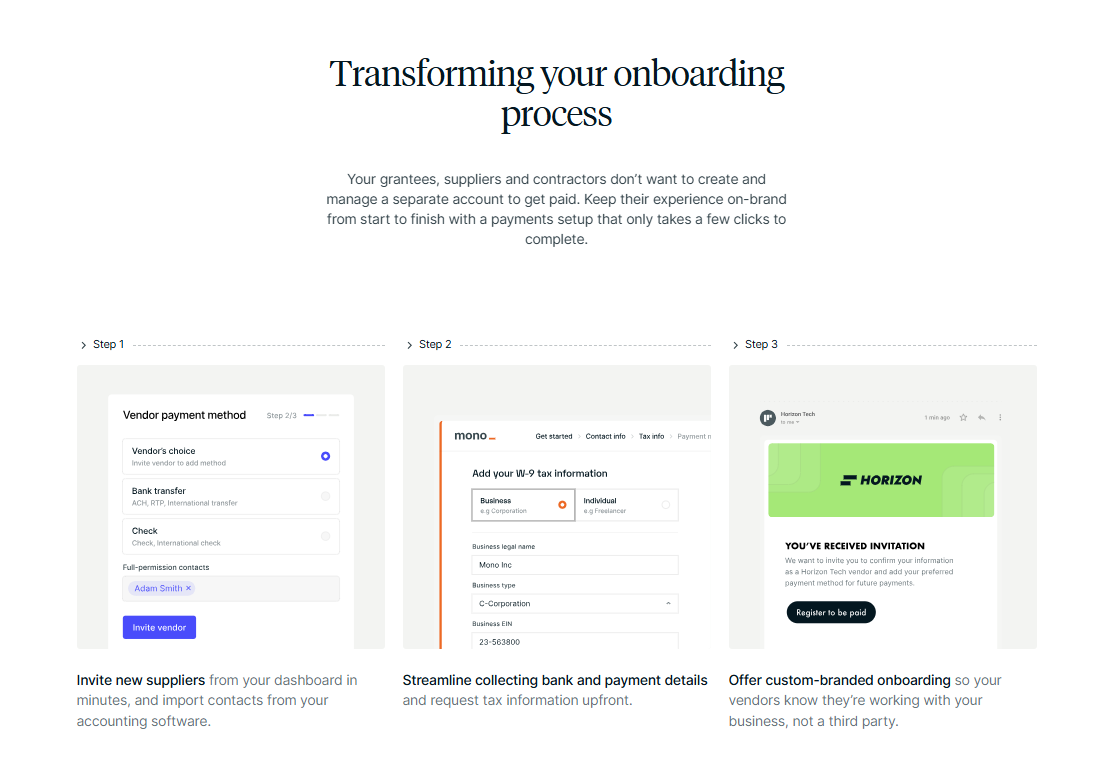
Payment APIs that collect tax forms during recipient onboarding eliminate year-end scrambles. When your grant system onboards a new recipient through an embedded API flow, W-8 or W-9 collection happens inline.
TIN validation runs immediately against IRS records, flagging mismatches before the first disbursement. Your grant system stores validated tax data alongside recipient profiles, creating a single source of truth that tracks cumulative payment totals throughout the year.
When total disbursements cross the $2000 threshold, the API flags 1099 requirements in real time. For international grantees, 1042-S tracking happens automatically based on recipient country and payment amounts.
Building Versus Buying: The Total Cost of Payment Infrastructure
Engineering leaders evaluating payment infrastructure face a deceptive cost calculation. Building appears cheaper at first glance: connect to a bank API, write disbursement logic, deploy. The ongoing costs surface later.
Every new payment rail requires separate integration work. ACH, wire, international rails, and push-to-card each demand distinct technical implementations. When compliance requirements change, your team owns the updates. TIN validation rules shift. Watchlist screening expands. Tax thresholds adjust annually.
Purpose-built disbursement APIs absorb these maintenance costs across their entire customer base. When 1099 reporting requirements change, the API provider updates their system once. You inherit the fix without deploying new code.
How Routable Powers API-First Grant Disbursements
Our API integrates in under three developer days. Your team connects to one REST endpoint handling domestic and international disbursements across ACH, wire, and local rails in 140+ currencies. No separate integrations per payment method.
Recipient onboarding runs through our white-label portal. Your grant management system sends an API call when approving a new grantee. We collect W-8 or W-9 forms, validate TIN against IRS records, and run watchlist screening. Grantees select payment preferences in your branded interface.
When triggering a disbursement, our 14 webhook events notify your system at each status change. Idempotency keys prevent duplicate payments if your API call retries during network issues.
Final Thoughts on Programmatic Grant Disbursements
The difference between manual payment operations and automated payout AP comes down to whether disbursements scale with your code or with your headcount. API-first architecture lets your grant management system trigger payments when milestones complete, recipients submit documentation, or compliance checks pass. Your engineering team ships once, and the same integration handles growing payment volumes without operational bottlenecks. Want to see how this works with your specific workflows?
Request a demo and we’ll show you the integration process.
FAQ
How long does it take to integrate a payment API into an existing grant management system?
Most engineering teams complete integration in 1-2 weeks with API-first payment solutions, compared to 4-8 weeks with legacy systems. REST APIs with sandbox environments, webhook support, and comprehensive documentation reduce implementation time by 3-5x.
What’s the difference between building your own payment infrastructure versus using a payment API?
Building requires separate integration work for each payment rail (ACH, wire, international), plus ongoing maintenance when compliance rules change. A purpose-built disbursement API maintains these updates across all customers, absorbing regulatory changes without requiring your team to deploy new code.
When should grant organizations move from manual CSV uploads to API-driven disbursements?
When processing over 500 monthly grants or when payment delays are creating grantee friction. API-driven disbursements eliminate manual data transfers between your grant system and payment portal, cutting distribution timelines from weeks to days while preventing errors from spreadsheet exports.
Can one API integration handle multiple payment methods for different recipient locations?
Yes—unified disbursement APIs route payments through the appropriate rail based on recipient location, banking capabilities, and delivery speed requirements. Your code submits one payment request, and the API handles ACH, wire, international rails, or push-to-card routing automatically.
How do API-embedded payments track 1042-S and 1099 requirements in real time?
Payment APIs collect W-8 or W-9 forms during recipient onboarding and validate TIN against IRS records immediately. The system tracks cumulative disbursement totals throughout the year and flags 1099 requirements automatically when a grantee crosses the $2000 threshold.