

If your business is experiencing high churn with gig workers (i.e., temporary workers, independent contractors, freelancers), it could be because you’re not paying them fast enough. Today, offering the option of instant, real-time payments is critical in maintaining a strong relationship with gig workers and helping prevent them from leaving for your competition.
Ahead, we’ll cover why slow gig worker payment methods might cause friction and why a faster option like real-time payments can keep gig workers engaged and motivated.
TLDR:
- Payout speed is no longer a perk; it’s a baseline expectation for gig workers in 2026.
- Stop relying on P2P wallets that frustrate workers with multi-day bank transfer delays and extra transaction fees.
- Implement real-time payments (RTP) to send funds directly to worker bank accounts 24/7/365, granting immediate access to earnings.
- Reduce churn and motivate your workforce by adopting an API-first payout solution that scales easily as your platform grows.
Why Do Folks Turn to Gig Work?
To say that the gig economy is on the rise is putting it lightly. A large number of workers in the U.S. participate in the gig economy either to supplement their primary source of income or through full time engagement, and the number of gig workers is increasing much faster than the whole of the U.S. workforce.
Gig workers turn to freelance work for many reasons, including supplemental income, flexible scheduling, and a better work-life balance. Gig work allows for travel without having to fill out PTO requests, creates an opportunity for family engagement while working from home, and it provides professional fulfillment while completing projects that align with interests and passions.
The Challenge of Slow Gig Worker Payments
But despite these quality-of-life benefits to a gig worker, the need to become viable or maintain viability is at the top of every gig worker’s mind. Getting paid matters, and getting paid regularly, dependably and without delay can be the difference between day-to-day expenses and being able to plan for larger purchases like a first home or professional development courses.
Not paying your gig workers quickly could sour the relationship and leave them looking for work elsewhere.
How Do Gig Economy Workers Get Paid?
Payment preferences have evolved considerably as the gig economy has matured. TransUnion research found that 62% of U.S. adults earned income from at least one gig platform in 2024, and 84% of freelancers say they would choose instant payments if given the option.
Getting paid quickly has become a core expectation, not a perk. P2P payment services like PayPal, Venmo, and Zelle remain common options, but their limitations are becoming harder for gig workers to ignore.
Challenges of Using PayPal for Gig Worker Payments
Gig workers enjoy these platforms because P2P (peer-to-peer) services are familiar and provide faster access to payments than checks, for example. But payment gateways are not bank accounts. Unless a payment can be made directly from the payment gateway, like using PayPal to make an online purchase, a gig worker has to transfer their funds to a bank account. These transfers can take up to three business days; a timeline that’s delayed by weekends and holidays. For a gig worker that has time-sensitive bills to pay like rent or utilities, these delays are not sustainable.
PayPal fees also add up. To send or receive money for goods and services, gig workers are subject to transaction fees. The rates increase further for international transactions. Then, once received through PayPal, a gig worker’s funds may be subject to additional fees for transferring those funds instantly to their bank account.
| Feature | P2P Services (e.g., PayPal) | Real-Time Payments (RTP) |
|---|---|---|
| Payout Speed | Up to 3 business days for bank transfers | Instant, available 24/7/365 |
| Payee Fees | Subject to transaction and instant transfer fees | No transfer fees to access earnings |
| Account Requirement | Requires a third-party app or digital wallet | Direct to existing bank account |
| Payment Tracking | Relies on app notifications | Instant bank settlement notification |
Making Gig Worker Payments Faster with Real-Time Payments
Offering a better payment experience will help keep your gig workers happy and engaged, and help prevent churn. For gig workers, a better payment experience means faster payments. And this can be especially important during uncertain economic times. According to the Federal Reserve’s 2024 Survey of Household Economics and Decisionmaking, 37% of adults would not cover an unexpected $400 expense using cash or its equivalent, and gig workers, who tend to have lower financial well-being than traditional full-time workers, are disproportionately affected. Having a faster payment option could offer peace of mind by covering these expenses quickly when needed.
What Are Real-Time Payments?
Real-time payments are an instant direct-to-bank payment method that gives gig workers immediate access to their hard-earned money. They receive payments 24/7, including weekends and holidays, and those funds are available for use right away.
Not every bank supports real-time payments yet, but adoption is growing rapidly. A majority of U.S. accounts are now reachable through real-time payment networks, driven by participation from many large banks.
How Do Real-Time Payments Work?
Real-time payments are credit transfers. In this setup, payments are pushed from the sender’s account into the recipient’s account. The amount needed to complete the transaction is verified before the transaction is initiated, which prevents any failed or delayed payments.
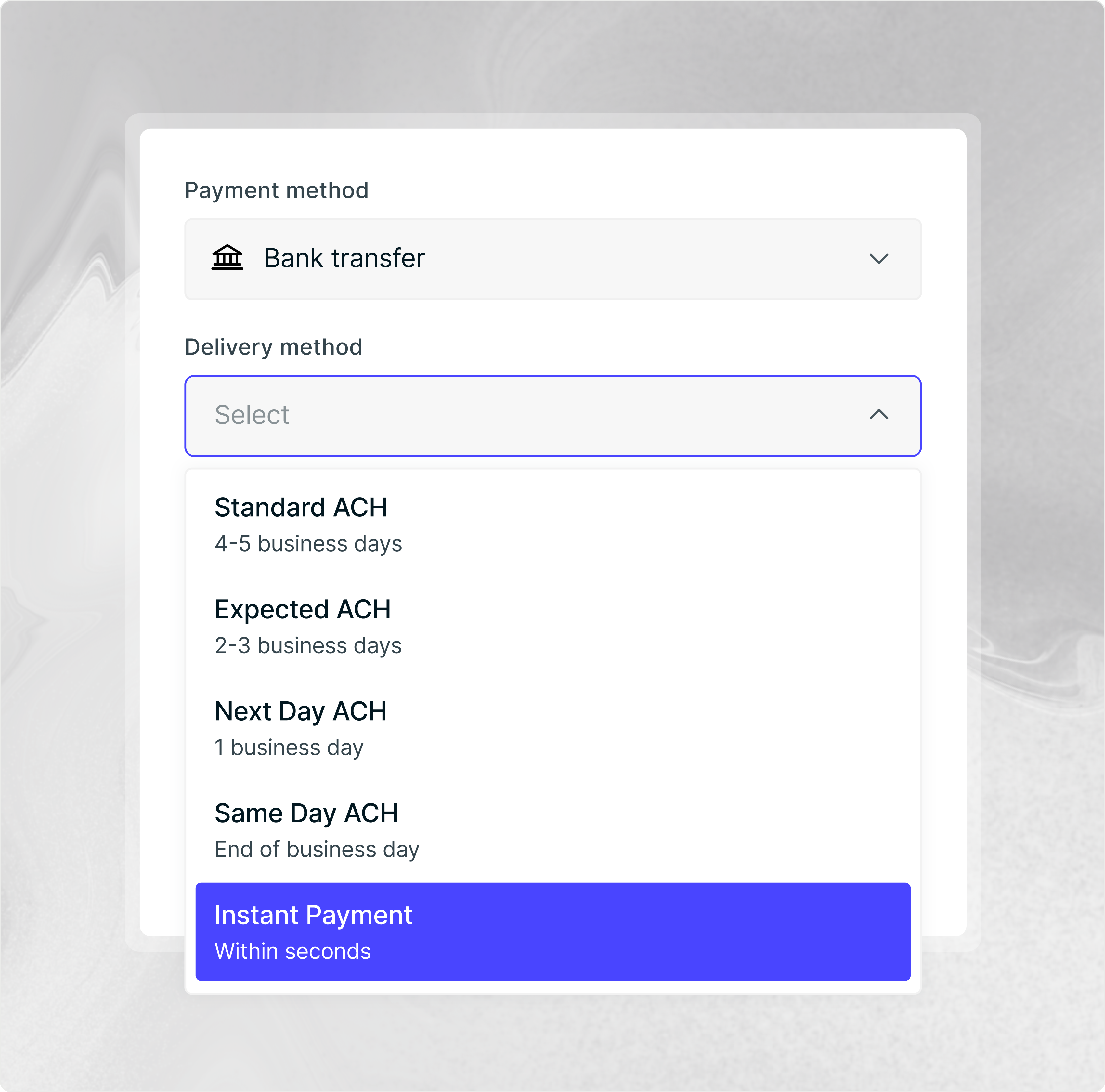
There are three steps in a real-time payment transfer, and once the payment is initiated, the payment settles right away.
- Initiate the payment with your bank. Confirm that your bank offers real-time payments and check that your account contains sufficient funds for the transfer. To initiate the payment, you’ll need to provide payment details about your gig worker, including their bank account and routing number.
- Your bank sends the payment request to the RTP® network. The RTP® network notifies your gig worker’s bank about the incoming transfer. The transaction details are secure and encrypted.
- The payment is settled. Funds are accepted by the receiving bank and become instantly available to your gig worker.
Benefits of Using Real-Time Payments for Gig Worker Payments
Real-time payments offer your gig workers an exceptional payment experience in several different ways.
No Back-and-Forth Communication About Payment Status
Getting paid instantly means that gig workers don’t have to track when their payments are coming, and they don’t have to check-in with you if a payment is late. RTP gives gig workers instant access to their money, and they’ll get a notification letting them know as soon as it happens.
No New Accounts for Gig Workers to Manage
Getting paid directly into a bank account means there are no additional passwords and usernames to manage or programs to learn.
Competitive Advantage for Your Business
Instant payments are the best option to gain an advantage over competing gig platforms and other businesses that may be offering slower payment methods.
Increased Worker Motivation
According to PYMNTS Intelligence research, 78% of Gen Z consumers used instant payouts in the past year, and among gig workers who depend on disbursements as core income, 68% become regular instant payout users after receiving one. By keeping gig workers paid on time and without delays, you’ll motivate them to stay active on your platform, and positive word of mouth can bring in new workers as well.
What’s Changing in 2026: Payout Speed as a Retention Lever
The pressure to pay gig workers faster has only grown stronger heading into 2026. Gig workers no longer view instant pay as a bonus. Instead, it is a baseline expectation. When expenses like fuel, utilities, and rent happen in real time, workers expect their earnings to arrive in real time too.
Platforms are taking note. Faster payouts are now widely recognized as a retention tool and more than a simple cost line. In a labor market where gig workers can switch between competing platforms quickly, payout timing has become part of the value proposition alongside the rate itself. Platforms that still rely on legacy batch-processing systems are finding it harder to keep workers engaged, as those systems were built for predictable pay cycles instead of the continuous earning model of today’s gig economy.
For businesses running gig operations, this shift means that investing in real-time payment infrastructure is no longer a nice-to-have. It directly affects whether your workforce stays active on your platform or moves to one that pays faster.
Using Routable to Send Real-Time Gig Worker Payments
Retaining gig workers requires competitive pay, but it also demands fast, dependable access to earnings. Slow payout methods and multi-day P2P transfers introduce friction that can push contractors toward competing platforms. By upgrading to real-time payments, you give your workforce the instant financial access they expect while simplifying your own finance workflows.
Offer your gig workers the best-in-class experience using RTP with Routable. When sending mass payouts with Routable, you can:
- Improve operations. Gain immediate advantage over competitors with instant payments and enjoy faster payout cycles with a 24/7/365 payment option.
- Ease finance team workload. Instant payments eliminate the back-and-forth of payment status communications and provide remittance information within transaction details, freeing finance teams up for more strategic tasks and faster payment reconciliation.
- Scale as you grow. Routable meets your needs of the moment with accounting software integrations (including real-time two-way syncing) and stays with you as you grow with flexible APIs. Whether you’re at 500 gig workers or ready to onboard 10,000, we help you meet your goals.
FAQ
What is a real-time payment for gig workers?
Real-time payments are instant, direct-to-bank credit transfers that give gig workers immediate access to their earnings 24/7. They settle immediately and make funds available even on weekends and holidays.
Why is PayPal not ideal for fast gig worker payouts?
While PayPal is a popular peer-to-peer option, workers must still transfer funds from their PayPal wallet to a bank account. This transfer can take up to three business days and often incurs extra transaction fees.
How do real-time payments work on the backend?
You initiate the payment with the recipient’s bank and routing details, your bank sends an encrypted request to the RTP® network, and the funds are instantly verified and settled in the worker’s account.
When should a business upgrade to real-time payments?
You should upgrade if you are experiencing high gig worker churn, scaling your workforce, or currently relying on manual batch processing that delays payouts and limits your platform’s competitive advantage.