
Your platform’s grown to the point where maintaining W-2 employees with guaranteed hours costs more than the value they generate during off-peak periods. Managing the W-2 to 1099 conversion process at scale requires more than updating tax forms—you need contractor agreements that pass IRS scrutiny, compensation rates that retain talent, and payment infrastructure that handles hundreds of 1099-NEC filings automatically. This guide covers the legal requirements, cost implications, and operational changes that determine whether your conversion actually improves your unit economics.
Note: Always consult with your tax professional regarding your specific financial situation and obligations. This article is neither legal advice nor tax advice. We recommend that you speak to your tax advisor with any questions or concerns around tax reporting.
TLDR:
- Converting W-2 employees to 1099 contractors saves 20-30% per worker by eliminating FICA, benefits, and payroll taxes
- You must collect W-9 forms during onboarding and file 1099-NEC by January 31 to avoid penalties
- IRS misclassification penalties start at $50 per worker for unintentional errors and reach $1,000+ for deliberate violations
- Contractors need 30% higher rates than W-2 wages to offset lost benefits and self-employment taxes
- Routable automates W-9 collection, 1099 filing, and mass contractor payouts with instant payment options across multiple rails
Understanding W-2 and 1099 Worker Classifications
The distinction between W-2 employees and 1099 contractors goes beyond tax forms. For companies running marketplaces, gig networks, or creator platforms, this classification shapes your entire payment operation.
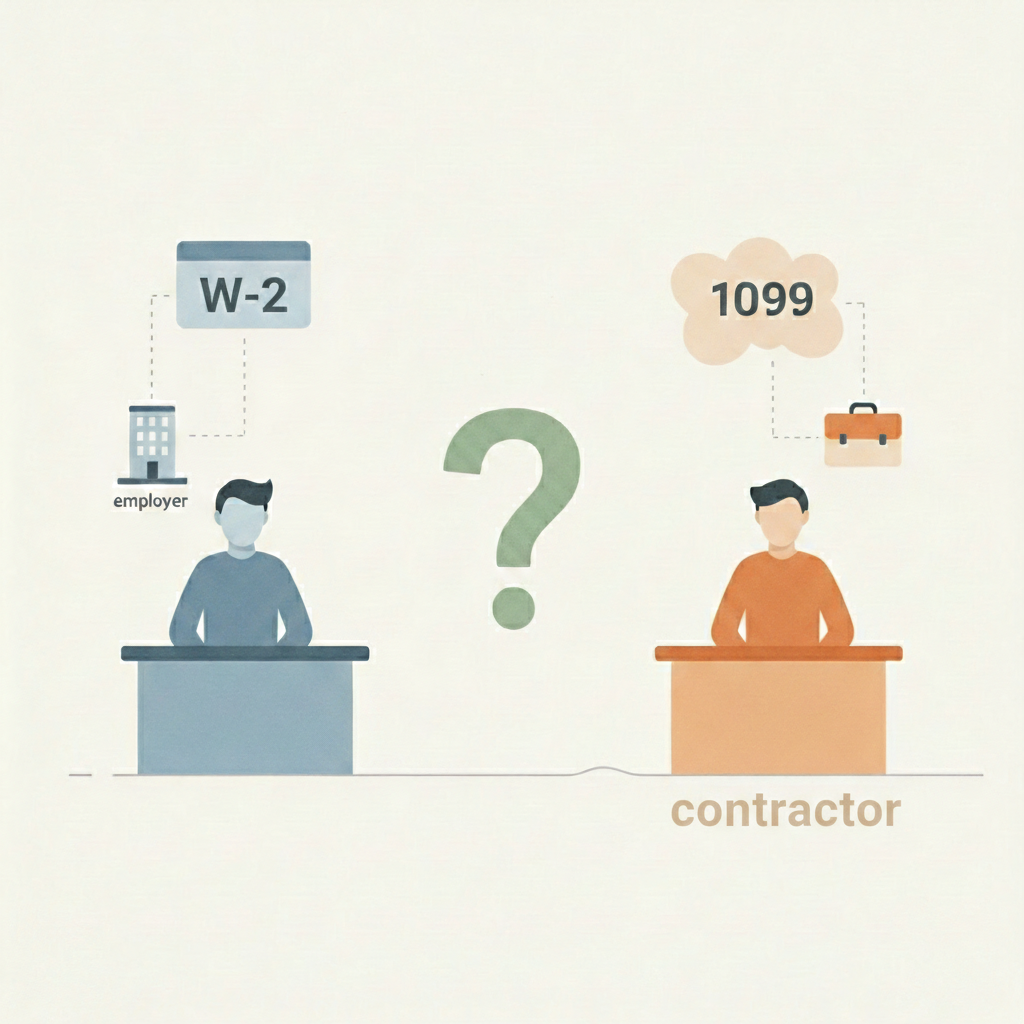
W-2 employees work under your direct control. You set their schedules, direct how they complete tasks, and provide tools and training. In return, you withhold payroll taxes, cover half of FICA, and typically provide benefits like health insurance.
1099 contractors operate independently. They control when and how they work, use their own equipment, and can serve multiple clients. You pay them for completed work without withholding taxes or providing benefits. They handle their own tax obligations.
When to Consider Converting Workers from W-2 to 1099
The conversion from W-2 to 1099 makes sense when your business requires variable capacity rather than fixed headcount. Marketplaces, gig networks, and creator platforms with fluctuating demand face cost structure problems when maintaining W-2 employees.
Consider conversion when:
- Work volume swings weekly or seasonally, making guaranteed hours impractical for your operations
- Workers prefer choosing their own schedules over fixed shifts
- You need access to a larger talent pool without long-term employment commitments
- Your competitors offer flexible, on-demand earning opportunities that attract top talent
The key signal: if you’re struggling to match worker availability with actual demand, the W-2 model may be working against you, and you need to explore how to pay 1099 contractors more effectively.
Cost Analysis: What Companies Save with W-2 to 1099 Conversion
Converting workers from W-2 to 1099 changes your cost structure in ways that matter for high-growth operations. Companies typically see savings between 20-30% per worker when accounting for all employment-related expenses.
The math breaks down across four major categories:
For a marketplace processing $1M in annual creator payouts, that 25% difference translates to $250K in freed capital for API development or market expansion.
IRS Classification Rules and Misclassification Risks
The IRS evaluates worker classification through three factors: behavioral control, financial control, and relationship type. Misclassification exposes your business to serious financial penalties.
Behavioral control examines whether you direct when, where, and how work happens. Financial control looks at whether workers can profit or lose based on their decisions. The relationship factor considers written contracts, benefits, and work continuity.
For unintentional errors, expect $50 per unfiled W-2, 1.5% of wages, and 40% of unpaid FICA taxes. Intentional misclassification brings penalties up to $1,000 per worker plus criminal prosecution risk.
Legal and Documentation Requirements for W-2 to 1099 Transition
Executing the transition requires four documentation steps to pass IRS scrutiny.
First, formally terminate the W-2 employment relationship. Issue final paychecks, complete final W-2 forms for the current tax year, and document the separation date. Clear termination prevents dual-status classification problems.
Second, create written independent contractor agreements before work resumes. These contracts should specify project-based deliverables, payment terms, and the contractor’s right to refuse work. The agreement protects both parties if the IRS questions the relationship.
Third, collect Form W-9 from each contractor before their first payment. This provides the Tax Identification Number needed for 1099 reporting. For marketplaces handling hundreds of contractors, automated W-9 collection during onboarding prevents year-end scrambles.
Fourth, For the 2025 tax year, file Form 1099-NEC if you pay $600 or more to contractors by February 2, 2026. Starting in 2026, the reporting threshold increases to $2,000 for payments made in that year.
Managing Dual Status Workers During Transition Periods
Workers transitioning mid-year require both W-2 and 1099-NEC reporting for the same calendar year. This dual-status scenario occurs when converting your workforce in phases or responding to seasonal demand shifts.
The IRS permits different classification periods within a single tax year if the change reflects a genuine shift in work relationship. Issue a W-2 for wages paid during the employment period and a 1099-NEC for contractor payments after the transition date.
Document the exact termination date, final W-2 paycheck date, and first 1099 payment date for each worker. This timeline proves the relationship changed legitimately rather than being manipulated for tax purposes. Collecting updated W-9 forms at the transition point creates a clear paper trail showing contractors voluntarily entered the new arrangement through proper vendor onboarding.
Setting Contractor Compensation Rates After Conversion
Converting workers from W-2 to 1099 without adjusting compensation damages talent retention in competitive gig markets. Workers lose employer-paid benefits and absorb the full tax burden, creating a real income cut if rates stay flat.
The baseline calculation: a worker earning $100,000 as a W-2 employee needs $130,000 or more as a 1099 contractor to break even. This 30% increase covers the employer portion of FICA (7.65%), lost benefits, and increased tax preparation costs.
Set contractor rates by calculating total W-2 employment cost, then converting that figure to project-based pricing or per-delivery rates. Review rates quarterly based on market conditions to stay competitive when other networks adjust payouts, and consider automating 1099 management to reduce overhead.
filing and contractor copy distribution, making it one of the earliest tax deadlines businesses face each year.
Contractor Onboarding and Payment Method Management
Gig networks and creator platforms lose talent when onboarding drags or payment choices stay limited. Contractors weigh your payout experience against every other earning option they have.
Companies running gig networks or creator platforms face a tax compliance challenge that scales with every new contractor added.
Collect W-9 forms during contractor onboarding, not at year-end. This timing prevents January scrambles when contractors have moved, changed numbers, or stopped responding. For marketplaces onboarding 50+ contractors monthly, manual email requests create bottlenecks that delay first payouts and frustrate workers eager to start earning.
Payment method choice keeps contractors active. Mass payouts for marketplaces should offer multiple rails: Same Day ACH for speed with traditional banking, Real-Time Payments for instant 24/7 transfers, push-to-card for workers without bank accounts, and international rails across 220+ countries. Workers who can switch from 3-day ACH to instant payments stay on your network instead of leaving for faster cash access.
Scaling W-2 to 1099 Conversion with Mass Payment Automation
Converting 100 workers from W-2 to 1099 is straightforward. Scaling to 1,000+ monthly payouts without adding headcount requires payment infrastructure built for volume.
Marketplaces and gig networks processing thousands of contractor disbursements hit bottlenecks with manual payment runs. CSV batch uploads or API-driven high-volume payout solutions let you execute mass disbursements in minutes rather than days, matching the payout speed expectations that keep contractors active on your network.
Automated W-9 collection during contractor onboarding and programmatic 1099-NEC filing remove year-end compliance scrambles. White-label payee portals let contractors self-serve their payment preferences and tax documentation without support tickets eating your operations capacity.

Final Thoughts on Building a 1099 Contractor Network
Moving from W-2 employees to 1099 contractors changes your cost structure and compliance obligations. Mass payment automation becomes critical when you’re processing thousands of contractor disbursements instead of fixed payroll runs. Workers stick with networks that pay them fast and give them payment choice, not just ones that classify them correctly. The companies scaling contractor networks successfully are automating both compliance and payment operations from day one.
Schedule a demo to see how API-driven payouts handle volume without adding headcount.
FAQ
How much should I increase contractor rates when converting from W-2 to 1099?
Plan to increase rates by 30% or more to keep talent competitive—a worker earning $100,000 as W-2 needs around $130,000 as 1099 to cover the employer FICA portion (7.65%), lost benefits, and higher tax obligations they now absorb.
What happens if I convert workers mid-year?
You’ll issue both a W-2 for their employment period and a 1099-NEC for contractor payments after the transition date, creating dual-status reporting for that tax year. Document the exact termination date and first contractor payment date to prove the relationship change was legitimate.
When is the 1099-NEC filing deadline?
For the 2025 tax year, you must file Form 1099-NEC for any contractor paid $600 or more by February 2, 2026. Beginning with the 2026 tax year, the reporting threshold rises to $2,000 for payments made during that year.
Can I process thousands of 1099 contractor payouts without hiring more staff?
Yes, with the right payment infrastructure. CSV batch uploads or API-driven disbursements let you execute mass contractor payouts in minutes, while automated W-9 collection and programmatic 1099-NEC filing remove year-end compliance bottlenecks that would otherwise require additional headcount.
What payment methods keep contractors active on gig networks?
Offer multiple payout rails so contractors can choose what works for them—Same Day ACH for fast traditional banking, Real-Time Payments for instant 24/7 transfers, push-to-card for workers without bank accounts, and international rails for global talent pools.