

Your payout volume just doubled, and the manual process that worked when you had 50 payees every month is now eating half your week with 500. Everyone compares mass payment API solutions by reading documentation that assumes you already know what idempotency keys and webhook coverage mean for your specific use case.
This guide walks through what separates production-ready mass payment APIs from legacy processors. You’ll see which features matter when you’re processing thousands of transactions daily, how to evaluate integration complexity, and what to prioritize based on your payee network’s size and geographic reach.
TLDR:
- Mass payment APIs automate high-volume disbursements for gig platforms, marketplaces, and creator networks by replacing manual CSV uploads and bank portals with programmatic batch processing that handles thousands of payments per request.
- Choose APIs based on batch size limits, multi-rail support (ACH, same-day ACH, real-time payments, push-to-card), webhook coverage for real-time status updates, and integration speed—leading solutions integrate in under five minutes with full production deployment in less than three developer days.
- Payment speed directly impacts retention: over 70% of independent workers will leave marketplaces for better payment experiences, and giving payees control over payout speed (instant vs. 4-5 day standard ACH) keeps them active on your service.
- Tax compliance runs automatically through W-8/W-9 form capture during onboarding, TIN validation against IRS records, and year-end 1042-S/1099 preparation—eliminating manual spreadsheet exports and regulatory risk.
- Start by mapping your payout volume, frequency, and geographic reach, then prioritize APIs that offer self-service payee portals, idempotency keys to prevent duplicate payments, and asynchronous processing for peak settlement times.
What Is a Mass Payment API
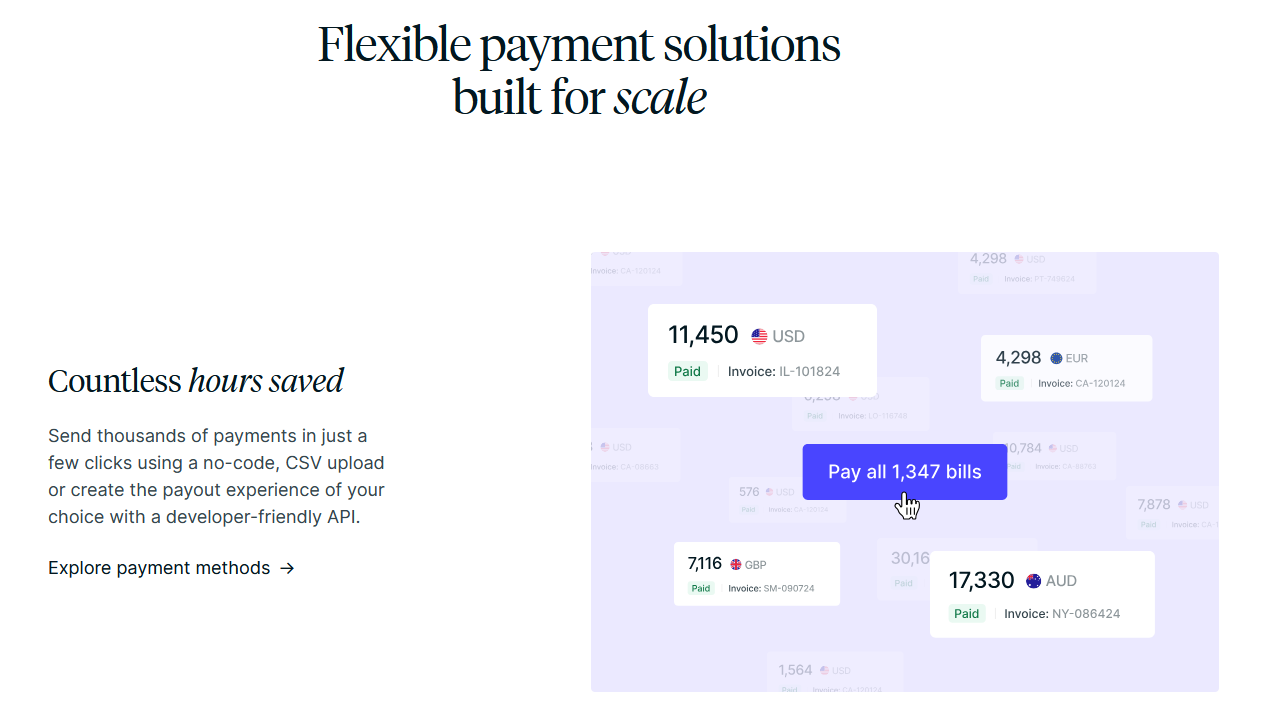
When you’re paying 10,000 gig drivers weekly or settling creator earnings daily, manual CSV uploads and bank portals don’t scale. A mass payment API automates disbursements programmatically. Send thousands of payments through a single request, get real-time status updates via webhooks, and let payees choose their payout speed.
For marketplaces, gig operators, and creator networks, this is core infrastructure. When you’re paying drivers after each shift, settling seller payouts daily, or disbursing creator earnings weekly, payment speed and reliability directly affect retention.
Mass payment APIs replace CSV exports, manual bank uploads, and multi-step approval chains with code that runs when a payout is calculated in your system. As the global payment processor market expands from $71.15 billion in 2026 to a projected $122.08 billion by 2031, API infrastructure is becoming the standard for embedded finance and real-time disbursements.
Core Features to Consider in a Mass Payment API
When comparing mass payment APIs, start with batch size, which defines how many payments you can push per request. Higher limits reduce API overhead for daily settlements. Webhook coverage should span submission, clearing, failure, and onboarding events so your application updates in real time without polling.
Multi-rail support lets payees choose ACH, same-day ACH, real-time payments, push-to-card, or international transfers from one endpoint. Payment method choice directly impacts retention. When gig workers access instant payouts instead of waiting 4-5 days for standard ACH, they stay active on your service.
Idempotency key support prevents duplicate payments during network retries. When you send a payout request with a unique key, the API caches the response for 24 hours, so retries with the same key return the cached result instead of processing a second payment.
Webhook Notifications and Real-Time Payment Tracking
Webhooks push status changes directly to your application. When a payout clears or fails, the API sends an HTTP POST to your endpoint with event data.
Event types vary by provider. Routable sends 14 different webhook events covering payable creation, status transitions, and payee onboarding completion. This lets you update internal dashboards, trigger confirmation emails, or flag exceptions without constant polling.
Real-time notifications let operations teams resolve issues before payees reach out.
API Integration Complexity and Developer Experience
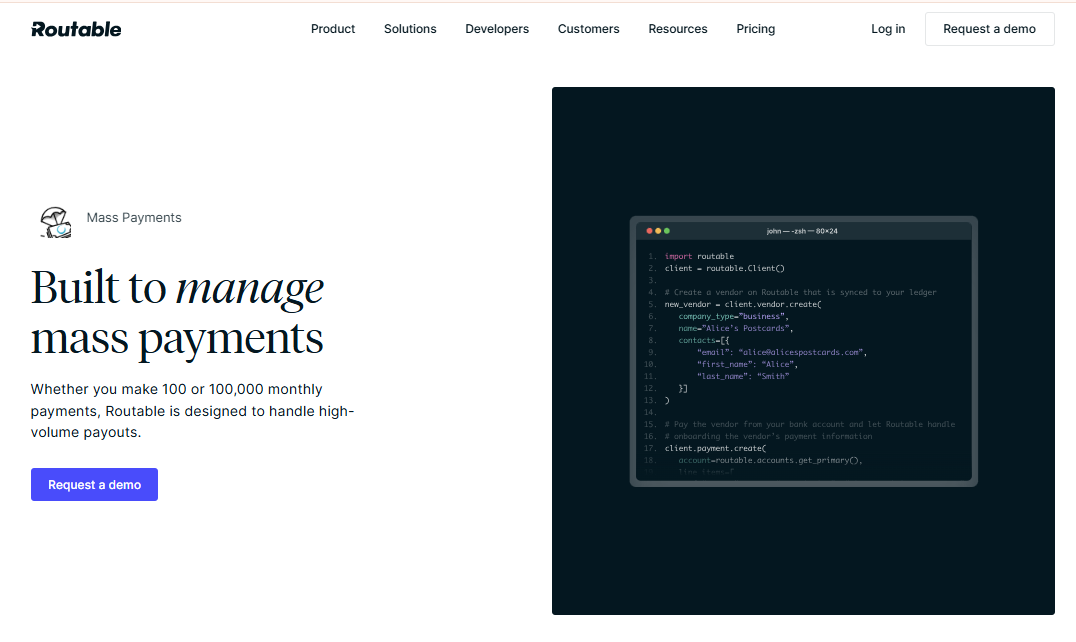
Integration timelines separate fast-moving APIs from legacy systems. Routable’s REST API ships in under five minutes for basic calls, with full integration taking less than three developer days.
Sandbox environments let you test batch flows, error handling, and webhook delivery without touching production funds. Documentation quality matters when edge cases surface. APIs that publish OpenAPI specs, provide working code samples in multiple languages, and maintain versioned changelog archives reduce integration friction.
Security, Compliance, and Tax Handling
Mass payment APIs automate tax collection during payee onboarding. When contractors or creators submit bank details, the API captures W-9 forms for U.S. recipients or W-8 series for international payees. TIN validation cross-checks submitted tax IDs against IRS records before the first payout processes. Compliance holds pause payments flagged for review, protecting your business from regulatory penalties.
Year-end tax filing moves from manual spreadsheet exports to automated 1099-NEC, 1099-MISC, and 1042-S preparation.
Scalability Considerations for High-Volume Payouts
Rate limits define how many API calls you can make per second or minute for high-volume payout solutions. When 50,000 drivers expect payouts at 5pm on Friday, hitting caps forces you to queue batches and implement retry logic. Asynchronous processing queues large payloads and returns batch IDs immediately instead of blocking until completion, which is critical when you’re settling daily earnings for thousands of gig workers who switch services over payout speed.
Choosing the Right Mass Payment API for Your Business
Start by mapping your payout volume and frequency. Daily settlements for gig workers require different infrastructure than monthly creator payouts. APIs charging per-transaction fees penalize high-volume operators, while subscription models with included transactions favor consistent batch sizes.
Geographic reach matters when your payee network spans borders, requiring international payout platforms. Confirm coverage for every country where recipients live, including developing markets. Check whether the API supports local rails for those regions or forces expensive SWIFT transfers.
Consider whether payment method choice sits with your ops team or individual payees. Self-service selection through branded portals reduces support inquiries when workers control payout speed. With over 70% of independent workers willing to leave their current freelancer marketplaces for better payment experiences and gig economy payouts estimated to hit $1 trillion by 2028, payment method choice directly impacts network loyalty and retention.
How Routable Powers Mass Payouts for High-Growth Operators
Routable is built for platforms where payment speed is a retention driver. When gig drivers, creators, or marketplace sellers expect payouts within hours, not days, your payment infrastructure stops being back-office plumbing and becomes part of your product experience.
The platform handles thousands of payments per batch through a REST API that integrates in under five minutes for basic calls. Full implementation takes less than three developer days. Webhook coverage spans 14 event types, from payable creation through clearing and failure notifications, so your dashboards update in real time without polling.
Payees control their payout speed through a white-label portal. They choose between same-day ACH, next-day ACH, real-time payments, or push-to-card based on how fast they need funds. When workers access instant payouts instead of waiting 4-5 days for standard ACH, they stay active on your service.
Tax compliance runs automatically during onboarding. The API captures W-9 forms for U.S. recipients and W-8 series for international payees, validates TINs against IRS records, and prepares year-end 1099-NEC, 1099-MISC, and 1042-S filings. Compliance holds pause payments flagged for review before they process.
International coverage reaches 220+ countries in 140+ currencies with 30-50% savings on foreign exchange rates compared to legacy processors. Whether you’re paying drivers in San Francisco or creators in Jakarta, the same API handles domestic ACH and cross-border transfers without separate integrations.
Final Thoughts on Building Mass Payout Infrastructure
The right mass payment API saves your team from manual batch processing while giving payees control over how fast they access funds. When you’re settling thousands of transactions daily, reliability and speed stop being nice-to-haves and become retention drivers. Start with the rails your payees actually want, then build from there.
FAQ
How long does mass payment API integration take?
Most APIs designed for high-volume payouts integrate in under five minutes for basic calls, with full production implementation taking less than three developer days. Legacy systems can require weeks of setup and custom configuration.
What’s the difference between batch size limits and rate limits?
Batch size defines how many payments you can include in a single API request, while rate limits control how many requests you can make per second or minute. High batch sizes reduce API overhead, but rate limits determine whether you can process 50,000 payouts at 5pm Friday without queuing.
Why do idempotency keys matter for mass payouts?
Idempotency keys prevent duplicate payments when network issues trigger automatic retries. The API caches your request for 24 hours, so retries with the same key return the cached result instead of processing a second payment to the same payee.
Can payees choose their own payout speed?
APIs with self-service portals let payees select between same-day ACH, next-day ACH, real-time payments, or push-to-card based on how fast they need funds. This choice directly impacts retention—gig workers who access instant payouts instead of waiting 4-5 days stay active on your service.
When should I prioritize webhook coverage over polling?
When you’re processing thousands of daily payouts and need real-time status updates without constant API calls. Webhooks push clearing, failure, and onboarding events directly to your application, letting you update dashboards and trigger notifications without manual polling overhead.