

The moment your payee count crosses 200, traditional payroll stops making financial sense for platform businesses. Moving to contractor payments cuts your per-worker cost by 30 percent through eliminated payroll taxes and benefits, but only if you nail worker classification and can actually disburse payments fast enough to compete for talent. This guide walks through the IRS tests that determine classification, the payment rails contractors actually prefer, and how to automate tax compliance before the tax filing deadline becomes a crisis.
Note: Always consult with your tax professional regarding your specific financial situation and obligations. This article is neither legal advice nor tax advice. We recommend that you speak to your tax advisor with any questions or concerns around tax reporting.
TLDR:
- Switching from W-2 to 1099 saves up to 30% by eliminating payroll taxes, benefits, and insurance costs
- You must pass IRS behavioral, financial, and relationship tests to classify workers as contractors legally
- Automated W-8/W-9 collection and TIN validation prevent IRS penalties when scaling to thousands of contractors
- API-driven payment infrastructure lets you trigger disbursements programmatically from your application without manual CSV uploads or payroll software
- Routable automates mass contractor payments via API or CSV with built-in tax compliance and multi-rail disbursement
Understanding the W-2 to 1099 Transition
The shift from W-2 employees to 1099 contractors changes how you structure work relationships across your network. With W-2 payroll, you withhold taxes, carry workers’ compensation, and manage benefit contributions. Contractors handle their own tax obligations and provide services on their terms.
The financial impact matters at scale. Savings reach up to 30 percent when paying independent contractors, driven by eliminated employer payroll taxes, benefits overhead, and unemployment insurance. For platforms disbursing payments to thousands of creators, drivers, or sellers weekly, these reductions accumulate quickly.
The 1099 model removes the requirement to guarantee hours or schedules. You pay for completed work, not clocked time. This works well when demand fluctuates or when your payee network operates across time zones. You trade direct control for operational flexibility, which fits platforms where workers already value independence.
Classification Rules and IRS Compliance
The IRS evaluates worker classification through three tests: behavioral control, financial control, and the relationship between parties. Behavioral control examines who directs when, where, and how work happens. If you dictate specific hours or methods, the relationship leans toward employment. Financial control looks at whether workers invest in their own equipment, incur unreimbursed expenses, or market services to others. Contractors typically manage their own costs and pursue multiple clients.
The relationship test considers contracts, benefits, and permanency. Ongoing relationships with exclusive commitments suggest employment. Project-based arrangements with defined scopes point toward contractor status. If you provide health insurance, paid leave, or retirement contributions, the IRS will scrutinize the classification.
Misclassification carries penalties including back taxes, interest, and fines. Marketplaces processing thousands of disbursements monthly face heightened exposure because volume multiplies liability. Before switching any cohort from W-2 to 1099, audit the relationship against all three factors. Document how contractors control their schedules, use their own tools, and serve other clients. This record protects you if the IRS questions your classification later.
Cost Analysis of Switching to Contractor Payments
Payroll taxes represent the most immediate savings. Employers pay 7.65 percent in FICA taxes for W-2 workers. With contractors, that expense disappears. For a marketplace paying 500 creators $50,000 each annually, switching eliminates $1.9 million in payroll tax.
Benefits add another layer. Health insurance, retirement matching, and paid time off typically cost 30 to 40 percent of base salary. Removing these obligations frees capital for product development or network expansion.
Workers’ compensation and unemployment insurance vanish under 1099 arrangements. Contractors manage their own coverage. Administrative costs also drop since you no longer process bi-weekly payroll or track accruals.
Calculate your break-even by comparing total W-2 burden against contractor rates. If your 1099 rates rise above combined W-2 salary plus taxes and benefits, the switch costs more. Map this across your entire payee cohort before moving forward. Volume matters because small per-payment differences scale across thousands of monthly disbursements.
Payment Methods for High-Volume Contractor Disbursements
Payment method strategy plays a direct role in contractor retention, especially in high-volume operations. When payouts are slow or limited to a single channel, contractors migrate to competitors that offer faster, more flexible options.
ACH remains the cost-efficient foundation. Standard ACH typically settles in four to five business days at the lowest per-transaction cost. Same Day ACH delivers funds by 6 p.m. ET when speed is necessary without significantly increasing fees. Real-time rails such as RTP and FedNow provide instant, 24/7/365 settlement, giving gig workers and creators immediate access to earnings the moment a task is completed.
Push-to-card enables payouts to debit cards within minutes, while P2P platforms like PayPal and Venmo meet contractors where they already manage their funds. Speed consistently shapes preference. Many workers choose instant methods over traditional ACH or checks, and marketplaces competing on payee experience increasingly need to support multiple rails. Slower disbursement options risk losing top performers to platforms that pay the same day.
Faster methods do come at a higher per-transaction cost. However, improved retention and reduced churn often offset the incremental fees. The right approach is to weigh contractor lifetime value against fee differences across your monthly disbursement volume and design a payout mix that balances cost efficiency with competitive advantage.
Tax Form Collection and 1099 Filing Requirements
Collect W-9 forms from every contractor before their first payment. The W-9 provides their legal name, business structure, and Taxpayer Identification Number (TIN). Without this information, you cannot file required tax forms or validate their identity against IRS records.
TIN validation matches the name and number against IRS databases. Mismatches trigger B-notices from the IRS, requiring you to request corrected information. Failed validation can lead to backup withholding requirements where you deduct 24 percent from payments and remit it to the IRS.
File Form 1099-NEC once a contractor’s annual payments meet the reporting threshold. The filing deadline for both contractor copies and federal submission is January 31. Late filings result in per-form penalties that increase the longer the delay continues.
At scale, manual collection breaks down. Chasing hundreds of payees for missing W-9s while managing disbursement schedules creates bottlenecks. Automated workflows collect tax forms during onboarding, validate TINs immediately, and flag incomplete submissions before you process the first payout.
Building Scalable Contractor Onboarding Workflows
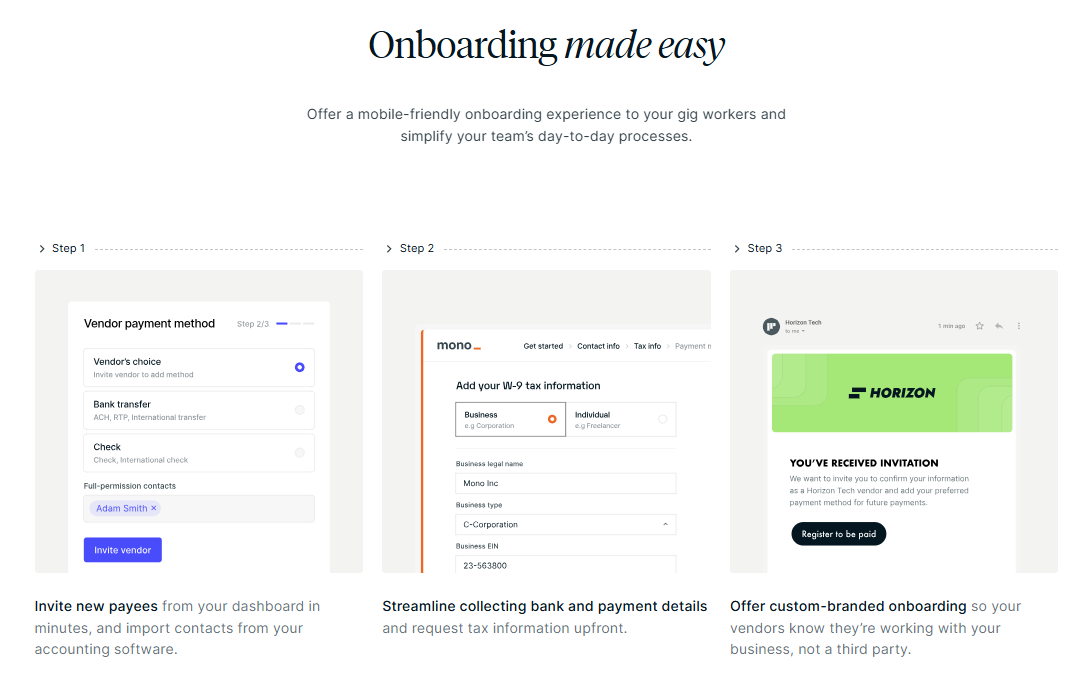
Self-service onboarding removes manual bottlenecks when scaling to hundreds or thousands of contractors. Instead of emailing spreadsheets or fielding support tickets, contractors complete setup independently through a branded portal accessible 24/7.
Automated payment method collection captures bank account details, debit card information, or P2P credentials during initial registration. Contractors select their preferred disbursement rail, and the system validates ownership before the first payout. This reduces fraud risk and failed payments before they happen.
White-label branding keeps the experience consistent with your product. Contractors see your logo, colors, and messaging throughout onboarding rather than a third-party interface. In competitive networks where payee experience drives retention, creators or drivers who onboard with multiple marketplaces remember the one that feels integrated and transparent.
Contractors also track payment status without contacting support. They see exactly when disbursements will arrive and through which method, reducing inquiry volume as you grow.
Setting Up Programmatic Payment Infrastructure
API-driven payment infrastructure lets you trigger disbursements programmatically from your application without manual CSV uploads or payroll software. When a creator completes a milestone or a driver finishes deliveries, your system calculates the payout and calls the payment API directly.
CSV batch uploads work for operations teams managing payments outside custom applications. Upload thousands of contractor disbursements in one file, map fields to your general ledger, and process everything in a single run. This removes the repetitive data entry that comes with traditional payroll systems designed for W-2 schedules.
Webhook notifications alert your application when payments clear, fail, or require attention. Your system receives real-time updates for each disbursement instead of polling payment status or manually checking dashboards. You can automatically notify contractors, update internal records, or retry failed payments without human intervention.
Idempotency keys prevent duplicate payments during network failures. If your API call times out, resending the request with the same key won’t create a second disbursement. This protects you when processing thousands of payouts where duplicate prevention at scale matters.
Automate Mass Payouts With Routable
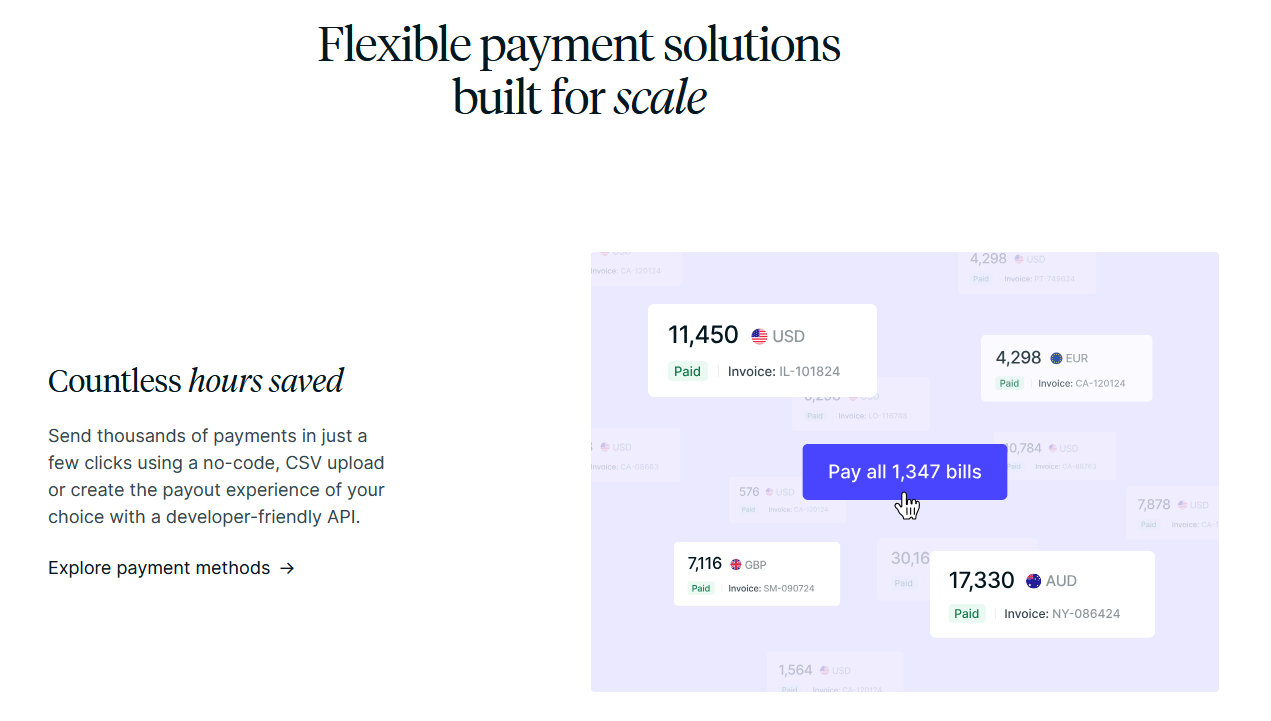
Routable handles the infrastructure challenge that comes with switching from payroll to contractor payments at scale. Send thousands of disbursements through a single API call or CSV upload without adding finance headcount. Your engineering team integrates in under three developer days, or your operations team processes batch files directly.
Multiple payment rails run through one system. Choose Same Day ACH, Real-Time Payments, push-to-card, or PayPal based on what your contractors prefer. They select their method during onboarding, and we route every disbursement accordingly.
W-8/W-9 collection happens automatically during contractor registration. TIN validation runs immediately, and 1042-S/1099-NEC forms generate at year-end without manual data assembly. Our bi-directional sync with NetSuite, QuickBooks, Intacct, and Xero keeps your general ledger current while contractors receive transparent payment tracking through a white-labeled portal.
Marketplaces, logistics networks, and creator businesses rely on Routable to execute the W-2-to-1099 transition without hiring more staff.
Final Thoughts on Contractor Payment Operations
Your success with contractor payments depends on infrastructure that keeps pace with network growth. Payment speed, tax automation, and multiple disbursement options separate marketplaces that retain top performers from those that lose them to competitors. Validate your IRS classification across all three tests, document contractor independence, and choose systems that scale without adding finance headcount.
Request a demo to see how other high-volume operations handle thousands of weekly disbursements through one API.
FAQ
How do I ensure workers are correctly classified as 1099 contractors?
Evaluate three IRS tests: behavioral control (do workers set their own schedules and methods?), financial control (do they invest in their own equipment and serve multiple clients?), and relationship type (are arrangements project-based without benefits?). Document how contractors control their work and maintain independence—this record protects you during audits.
What payment methods do contractors prefer for high-volume disbursements?
80 percent of gig workers prefer instant payment methods over traditional ACH or checks. Same Day ACH, Real-Time Payments, and push-to-card options deliver funds within minutes to hours, while standard ACH takes 4-5 business days. Offering multiple rails improves retention since contractors often choose platforms based on disbursement speed.
Can payroll software handle contractor payments?
Traditional payroll software is built for W-2 wage calculations, tax withholding, and benefits administration—not contractor disbursements. Most payroll systems lack multi-rail payment options (Same Day ACH, RTP, push-to-card), automated W-9 collection, or API access for programmatic payouts. Purpose-built contractor payment infrastructure handles 1099 workflows, TIN validation, and flexible disbursement methods that payroll platforms cannot support at scale.
Can I process thousands of contractor payments without adding finance staff?
API-driven payment infrastructure lets your system trigger disbursements programmatically when milestones complete, while CSV batch uploads handle bulk payments without manual data entry. Automated W-9 collection, TIN validation, and 1099 generation remove the administrative bottlenecks that typically require additional headcount as contractor networks grow.